Vegetos

(An International Journal of Plant Research & Biotechnology)
(eISSN: 2229-4473)
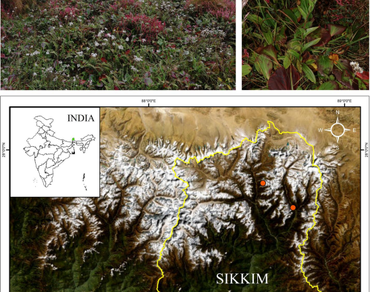
Recollection of Anaphalis subumbellata (Asteraceae: Gnaphalieae) after 114 years from India (Sikkim, Eastern Himalaya), with typification and conservation assessment
*Article not assigned to an issue yet
Research Articles | Published: 17 October, 2026
First Page: 0
Last Page: 0
Views: 67
Keywords: Endangered, Cypsela, Lectotype, Gnathang valley, n Anaphalis nepalensisn
Abstract
Anaphalis subumbellata C.B. Clarke is a lesser-known species represented by very few collections. The species was recollected from Gnathang, Pakyong District, Sikkim after 114 years in India. Its last documented collection from India was made from the same locality in 1910. Detailed taxonomic study revealed that the leaf texture, indumentum, glandular surface, venation, shape and margin provide important diagnostic characters for distinguishing the species from closely allied taxa. An updated description, notes on distribution, a detailed photoplate and scanning electron micrographs of the cypselae are provided here for the first time. The name A. subumbellata is lectotypified to ensure nomenclatural stability. Based on available distributional records and field observations conducted during 2023 and 2024, the species is provisionally assessed as Endangered in India. The recollection confirms the continued occurrence of this rarely collected species in India after more than a century while highlighting its restricted distribution, small population size and need for conservation attention.
References
Abid R, Qaiser M (2007) Cypsela morphology of the genus Anaphalis DC. (Gnaphalieae–Asteraceae) from Pakistan. Pak J Bot 39:1897–1906
Anderberg AA (1991) Taxonomy and phylogeny of the tribe Gnaphalieae (Asteraceae). Opera Bot 104:1–195
Bachman S, Moat J, Hill A, de la Torre J, Scott B (2011) Supporting Red List threat assessments with GeoCAT: geospatial conservation assessment tool. ZooKeys 150:117–126. https://doi.org/10.3897/zookeys.150.2109
Beauverd G (1913) La constante générique des Anaphalis DC. Bull Soc Bot Genève 2:146–147
Beentje H (2010) The Kew plant glossary: An illustrated dictionary of plant terms. Royal Botanic Gardens, Kew
Bentham G, Hooker JD (1873) Genera plantarum, vol 2. Lovell Reeve and Co., London, p 303
Clarke CB (1876) Compositae Indicae descriptae et secus genera Benthamii ordinatae. W. Thacker and Co., London, p 108. https://doi.org/10.5962/bhl.title.49202
de Candolle AP (1838) Prodromus systematis naturalis regni vegetabilis, vol 6. Treuttel and Würtz, Paris, pp 271–275. https://doi.org/10.5962/bhl.title.286
Drury DG (1970) A fresh approach to the classification of the genus Gnaphalium with particular reference to the species present in New Zealand (Inuleae–Compositae). N Z J Bot 8(2):222–248. https://doi.org/10.1080/0028825X.1970.10429122
Glenny D (1997) A revision of the genus Anaphalioides (Asteraceae: Gnaphalieae). N Z J Bot 35(4):451–477. https://doi.org/10.1080/0028825X.1987.10410170
Grierson AJC, Long DG (2001) Anaphalis. In: Springate LS (ed) Flora of Bhutan, including a record of plants from Sikkim and Darjeeling, vol 2. Pt 3. Royal Botanic Garden Edinburgh, Edinburgh, pp 1515–1522
Hooker JD (1881) Anaphalis. In: Hooker JD (ed) Flora of British India, Vol. 3(8). L Reeve & Co., London, pp 279–287. https://doi.org/10.5962/bhl.title.678
Hooker JD (1854) Himalayan journals; or notes of a naturalist in Bengal, the Sikkim and Nepal Himalayas, the Khasia mountains, etc., Vol. 2. John Murray, London
IUCN (2012) Guidelines for Application of IUCN Red List Criteria at Regional and National Levels: Version 4.0. IUCN, Gland, Switzerland and Cambridge, UK. Available at https://www.iucnredlist.org/resources/regionalguidelines
IUCN Standards and Petitions Committee (2024) Guidelines for Using the IUCN Red List Categories and Criteria, Version 16. Prepared by the Standards and Petitions Committee. https://www.iucnredlist.org/documents/RedListGuidelines.pdf
Karthikeyan S, Sanjappa M, Bhattacharjee B, Dash SS, Meena SL, Mastakar VK (2020) Asteraceae. In: Mao AA, Dash SS (eds) Flowering plants of India: an annotated checklist. Dicotyledons, vol 1. Botanical Survey of India, Kolkata, pp 713–816
Kushwaha PS, Bhattacharjee A (2025) A comprehensive overview of the genus Anaphalis DC. (Asteraceae: Gnaphalieae) in India. Nelumbo 67(2):45–61. https://doi.org/10.20324/nelumbo/v67/2025/173513
Mabberley DJ (2018) Mabberley’s Plant-Book: A Portable Dictionary of Plants, their Classification and Uses, 4th edn. Cambridge University Press, New Delhi, p 46
Narasimhan D, Irwin SJ (2021) Flowering plants of Tamil Nadu: a compendium. Care Earth Trust, Chennai, pp 167–169
Nie ZL, Funk V, Sun H, Deng T, Meng Y, Wen J (2013) Molecular phylogeny of Anaphalis (Asteraceae, Gnaphalieae) with biogeographic implications in the Northern Hemisphere. J Plant Res 126(1):17–32. https://doi.org/10.1007/s10265-012-0506-6
Pant PC (1995) Gnaphalieae. In: Hajra PK, Rao RR, Singh DK, Uniyal BP (eds) Flora of India: Asteraceae (Inuleae–Vernonieae), vol 13. Botanical Survey of India, Calcutta, pp 51–84
POWO (2026) Plants of the World Online. Facilitated by the Royal Botanic Gardens, Kew. https://powo.science.kew.org/. Accessed on 03 September 2026
Press JR, Shrestha KK, Sutton DA (2000) Annotated Checklist of the Flowering Plants of Nepal. The Natural History Museum, London
Singh P, Karthigeyan K, Lakshminarasimhan P, Dash SS (2015) Endemic Vascular Plants of India. Botanical Survey of India, Kolkata
Stafleu FA, Cowan RS (1979) Taxonomic literature: a selective guide to botanical publications and collections with dates, commentaries and types, vol Vol 2H–Le, 2nd edn. Bohn, Scheltema and Holkema, Utrecht. https://www.sil.si.edu/DigitalCollections/tl-2/
Thiers BM (2026) continuously updated) Index Herbariorum: A Global Directory of Public Herbaria and Associated Staff. New York Botanical Garden’s Virtual Herbarium, New York. http://sweetgum.nybg.org/science/ih/
Turland NJ, Wiersema JH, Barrie FR, Gandhi KN, Gravendyck J, Greuter W, Hawksworth DL, Herendeen PS, Klopper RR, Knapp S, Kusber WH, Li DZ, May TW, Monro AM, Prado J, Price MJ, Smith GF, Senoret JCZ (2025) International Code of Nomenclature for algae, fungi, and plants (Madrid Code) Regnum Vegetabile 162. The University of Chicago Press, London. https://www.iaptglobal.org/_functions/code/madrid
Xu X, Wei Z, Zhang T, Zhu S (2021) Achene micro-morphology of Anaphalis DC. (Gnaphalieae–Asteraceae) from China. Pak J Bot 53(5):1883–1892. https://doi.org/10.30848/PJB2021-5(10)
Remya S, Prabhukumar KM, Muhsina AA, Kanakambika G, Smitha M, Maya CN (2026) Anaphalis rosmarinifolia (Asteraceae: Asteroideae: Gnaphalieae): a new species from southern Western Ghats, India. Kew Bull. https://doi.org/10.1007/s12225-025-10354-0
Lepcha D, Lepcha P, Ganesan R, Tangjang S (2026) Rediscovery of Henckelia lachenensis (Gesneriaceae) in the Sikkim Himalaya after 176 Years. Rheedea 35(3):134–137. https://doi.org/10.22244/rheedea.2025.35.03.05
Mahesh Y, Lytan R, Kottaimuthu R (2026) Rediscovery of Chamaegastrodia vaginata (Hook.f.) Seidenf. (Orchidaceae: Goodyerinae) after a gap of 175 years from its type locality. Vegetos. https://doi.org/10.1007/s42535-025-01592-5
Maity D (2021) Rediscovery of Pedicularis globifera (Orobanchaceae) in India after 110 Years. J Jap Bot 96(5):304–307. https://doi.org/10.51033/jjapbot.96_5_11126
Author Information
Botanical Survey of India, Central National Herbarium, Howrah, India