Vegetos

(An International Journal of Plant Research & Biotechnology)
(eISSN: 2229-4473)
Soilless cultivation of Dracaena fragrans: impact of nutrient formulations on vegetative, biochemical and post-harvest traits
*Article not assigned to an issue yet
Research Article | Published: 10 June, 2026
First Page: 0
Last Page: 0
Views: 92
Keywords: Hydroponics, Soilless culture, n Dracaena fragransn , Cut foliage, Nutrient solution
Abstract
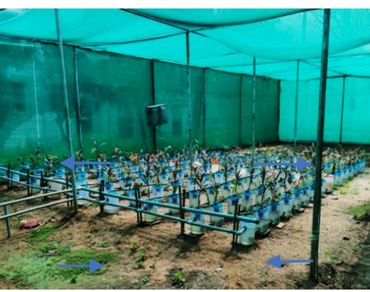
Hydroponic cultivation offers a promising approach for producing high-quality cut foliage with efficient nutrient and water use. This study evaluated the impact of different nutrient formulations on the vegetative, biochemical and postharvest attributes of Dracaena fragrans grown under a soilless culture system. Three-month-old plants were cultivated in a closed hydroponic system with light expandable clay aggregates as the medium and irrigated via drip system. Eight nutrient treatments including Hoagland and Arnon (T2), Hewitt (T3), Colakoglu-1 and − 2 (T4 & T5), Steiner (T6), Bollard (T7), Middleton and Toxopeus (T8), along with water-soluble fertilizer (19:19:19 NPK) (T9) and rainwater control (T1), were tested in a Completely Randomized Block Design. Among all treatments, T2 exhibited superior vegetative performance, recording the highest leaf area index (2.84), leaf area duration (69.80 days), and crop growth rate (3.16 g m−² day¹). Biochemically, T2 also had higher carotene (5.78 mg/g), proline (0.23 mg/g), and total phenol (6.60 mg/g) levels, which may be associated with improved stress tolerance and physiological stability in D. fragrans. Correspondingly, T2 improved postharvest quality, showing the highest chlorophyll stability, membrane integrity, longest vase life and lowest weight loss. These results demonstrate that the Hoagland and Arnon formulation effectively optimizes growth, stress resilience, and marketable quality of D. fragrans under hydroponic conditions, highlighting its potential for commercial cut-foliage production.
References
Aziz MA, Ooi HI, Rashid AA (1996) In vitro responses of Dracaena fragrans cv. Massangeana to growth regulators. Pertanika J Trop Agric Sci 19(3):123–127
Bates LS, Waldren RP, Teare ID (1973) Rapid determination of free proline for water-stress studies. Plant Soil 39:205–207. https://doi.org/10.1007/BF00018060
Bollard EG (1966) A comparative study of the ability of organic nitrogenous compounds to serve as sole sources of nitrogen for the growth of plants. Plant Soil 25:153–166
Garg A, Thakur T (2024) Cut foliage and cut greens. Agric Food E-Newslett 6(4):412–414
He L, Xu W, Zhou D, Yan J, Jin H, Zhang H, Cui J, Miao C, Zhang Y, Zhou Q, Yu J, Yu X, Ding X (2024) The impact of nutrient solution electrical conductivity on leaf transcriptome contributing to the fruit quality of cucumber grown in coir cultivation. Int J Mol Sci 25(22):11864. https://doi.org/10.3390/ijms252211864
Hewitt EJ (1966) Sand and water culture methods used in the study of plant nutrition. technical communication no. 22, C.A.B. Farnham Royal, UK, p 560
Hoagland DR, Arnon DI (1950) The water culture method for growing plants without soil. Calif Agric Exp Stn Circ 347:1–32
Jensen A (1978) Chlorophylls and carotenoids. Handbook of Phycological Methods. Cambridge University Press, Cambridge, pp 59–70
Kaloyereas SA (1958) A new method of determining drought resistance. Plant Physiol 33(3):232
Kilinc SS, Ertan E, Seferoglu S (2007) Effects of different nutrient solution formulations on morphological and biochemical characteristics of nursery fig trees grown in substrate culture. Sci Hortic 113(1):20–27
Leopold AC, Musgrave ME, Williams KM (1981) Solute leakage resulting from leaf desiccation. Plant Physiol 68(6):1222–1225
Manivannan N (2014) TNAUSTAT: Statistical package for agricultural research. Tamil Nadu Agricultural University, Coimbatore, India. Available at: http://www.tnau.ac.in (accessed 13 March 2023)
Menegaes JF, Nunes UR, Bellé RA, Backes FA (2019) Post-harvesting of cut flowers and ornamental plants. Sci Agrar Parana 18(3):313–323
Middleton KR, Toxopeus MRJ (1973) Diagnosis and measurement of multiple soil deficiencies by a subtractive technique. Plant Soil 38:219–226
Naseri E, Dalir N, Mokhtassi-Bidgoli A, Ebadi MT, Rahnemaie R (2025) Optimizing saffron cormlet production through substrate composition, nutrient concentration and irrigation management in soilless cultivation. Sci Rep 15(1):36. https://doi.org/10.1038/s41598-024-81282-5
Nerlich A, Dannehl D (2021) Soilless cultivation: dynamically changing chemical properties and physical conditions of organic substrates influence the plant phenotype of lettuce. Front Plant Sci 11:601455. https://doi.org/10.3389/fpls.2020.601455
Power J, Willis W, Grunes D, Reichman G (1967) Effect of soil temperature, phosphorus, and plant age on growth analysis of barley. Agron J 59(3):231–234
Raju Dantuluri V, Misra R, Singh V (2008) Effect of polyamines on postharvest life of gladiolus spikes. J Ornam Hortic 11(1):66–68
Shamna P (2024) Economic analysis of cut foliage in Malappuram and Ernakulam districts. M.Sc. (Ag.) Thesis, Kerala Agricultural University, Thrissur, India, 97 p
Somogyi M (1952) Notes on sugar determination. J Biol Chem 195:19–23
Sonneveld C, Voogt W (1983) Studies on the salt tolerance of some flower crops grown under glass. Plant Soil 74(1):41–52
Stamps RH, Conover CA (1986) Cut foliage production in Florida. HortScience 21(2):178–339
Steiner AA (1984) The universal nutrient solution. In: Proceedings of the 6th International Congress on Soilless Culture. ISOSC, Wageningen, pp 633–649
Verma D, Singh O, Deshmukh A, Gontia A (2017) Study on crop growth rate and relative growth rate of analytical parameters in wheat, barley and oat. Int J Curr Microbiol Appl Sci 6(9):1341–1347
Vishnupandi S, Thangaselvabai T (2019) Effect of different nutrient formulations on growth and yield of Cordyline fruticosa grown in soilless culture system. J Agric Ecol 8(8):24–29
Watson DJ (1947) Comparative physiological studies on the growth of field crops: I. Variation in net assimilation rate and leaf area between species and varieties, and within and between years. Ann Bot 11(41):41–76
Watson DJ (1958) The dependence of net assimilation rate on leaf-area index. Ann Bot 22(1):37–54
Zakaria NI, Ismail MR, Awang Y, Megat Wahab PE, Berahim Z (2020) Effect of root restriction on the growth, photosynthesis rate, and source–sink relationship of chilli (Capsicum annuum L.) grown in soilless culture. Biomed Res Int 2020:2706937. https://doi.org/10.1155/2020/2706937
Author Information
Department of Floriculture and Landscape Architecture, Tamil Nadu Agricultural University, Coimbatore, India