Vegetos

(An International Journal of Plant Research & Biotechnology)
(eISSN: 2229-4473)
The influence of zinc excess and the potential for minimizing its adverse effects in wheat plants through salicylic acid treatment
*Article not assigned to an issue yet
Ignatenko Anna, Nilova Irina, Kholoptseva Ekaterina, Kaznina Natalia, Titov Alexander
Research Articles | Published: 22 August, 2026
First Page: 0
Last Page: 0
Views: 80
Keywords: Growth, Photosynthesis, Plant hormones, Pigments, Wheat, Zinc excess
Abstract
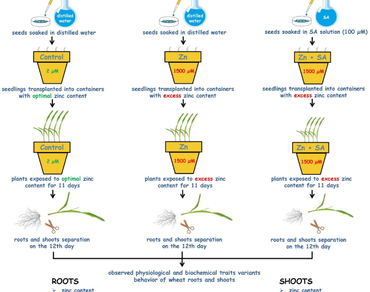
The impact of heavy metals is one of the adverse environmental factors that has been demonstrated to negatively affect crop vitality. In this regard, finding environmentally friendly and economically efficient strategies to address this issue is a priority direction in agriculture. Studies indicate that treatment of plants with phytohormones is one of the promising approaches. The present study investigated the influence of zinc excess on wheat plants, as well as the efficiency of salicylic acid (SA) seed treatment for minimizing the adverse effects of this metal. The following indicators were evaluated in the work: zinc content in roots and shoots, biomass accumulation, content of photosynthetic pigments in leaves, potential quantum yield of photosystem II (Fv/Fm), rate of CO2 assimilation, root and shoot water content, intensity of transpiration, and water-use efficiency (WUE). It has been shown that zinc excess (1500 ?M) leads to an increase in its content in shoots and roots, and a decrease in the accumulation of their fresh biomass. Plants exposed to excess zinc experience a decrease in chlorophyll a and b content, the rate of CO2 assimilation, and the potential quantum yield of photosystem II (Fv/Fm). Moreover, the rate of transpiration and water content in roots and shoots also decreased. Seed treatment with SA (100 µM) did not affect zinc accumulation, but it enhanced inhibition of root fresh and dry biomass accumulation under zinc excess. At the same time, the chlorophyll a and b content and the rate of CO2 assimilation were higher compared to untreated plants.Transpiration intensity, WUE and root and shoot water content under seed treatment with SA remained unchanged under stress conditions. It was concluded that the use of SA at a concentration of 100 ?M only partially minimized the negative effect of zinc excess on wheat plants.
References
Anas M, Falak A, Hassan S, Khattak WA, Hamzah Saleem M, Khan KA, Khalid A, Fahad S (2025) Microbial interactions and bacterial responses to metal stress in plants: mechanisms, adaptations, and applications for sustainable agriculture. J Crop Health 77:36. https://doi.org/10.1007/s10343-025-01108-w
Asare MO, Száková J, Tlustoš P, Kumar M (2025) Zinc contamination in soils and its implications on plant phytoalexins. Int J Environ Sci Technol 22:8581–8600. https://doi.org/10.1007/s13762-025-06437-x
Bagautdinova ZZ, Omelyanchuk N, Tyapkin AV, Kovrizhnykh VV, Lavrekha VV, Zemlyanskaya EV (2022) Salicylic acid in root growth and development. Int J Mol Sci 23:2228. https://doi.org/10.3390/ijms23042228
Broadley MR, White PJ, Hammond JP, Zelko I, Lux A (2007) Zinc in plants. New Phytol 173:677–702. https://doi.org/10.1111/j.1469-8137.2007.01996.x
Dmitrieva SA, Ponomareva AA, Minibaeva FV, Gordon LH (2008) ROS and proton mediated effects of salicylic acid on the growth and ultrastructure of cells in wheat roots. Uchenye Zapiski Kazanskogo Gosudarstvennogo Universiteta 150:123–135 ((In Russ.))
Dobrikova A, Apostolova E, Han? A, Yotsova E, Borisova P, Sperdouli I, Adamakis IS, Moustakas M (2021) Tolerance mechanisms of the aromatic and medicinal plant Salvia sclarea L. to excess zinc. Plants (Basel) 10:194. https://doi.org/10.3390/plants10020194
Elsisi M, Elshiekh M, Sabry N, Aziz M, Attia K, Islam F, Chen J, Abdelrahman M (2024) The genetic orchestra of salicylic acid in plant resilience to climate change induced abiotic stress: critical review. Stress Biol 4:31. https://doi.org/10.1007/s44154-024-00160-2
GOST EN 14084–2014 . Foodstuffs. Determination of trace elements. Determination of lead, cadmium, zinc, copper and iron by atomic absorption spectrometry (AAS) after microwave digestion. Adopted: October 20th, 2014.
Feigl G, Molnár A, Sz?ll?si R, Ördög A, Tör?csik K, Oláh D, Bodor A, Perei K, Kolbert Z (2019) Zinc-induced root architectural changes of rhizotron-grown B. napus correlate with a differential nitro-oxidative response. Nitric Oxide 90:55–65
Gill RA, Zhang N, Ali B, Farooq MA, Xu J, Gill MB, Mao B, Zhou W (2016) Role of exogenous salicylic acid in regulating physio-morphic and molecular changes under chromium toxicity in black- and yellow-seeded Brassica napus L. Environ Sci Poll Res 23:20483–20496
Gil’vanova IR, Enikeev AR, Stepanov SY, Rakhmankulova ZF (2012) Involvement of salicylic acid and nitric oxide in protective reactions of wheat under the influence of heavy metals. Appl Biochem Microbiol 48:90–94
Gitto A, Fricke W (2018) Zinc treatment of hydroponically grown barley plants causes a reduction in root and cell hydraulic conductivity and isoform-dependent decrease in aquaporin gene expression. Physiol Plant 164:176–190
Gli?ska S, Gapi?ska M, Michlewska S, Skiba E, Kubicki J (2016) Analysis of Triticum aestivum seedling response to the excess of zinc. Protoplasma 253:367–377
Huang YT, Cai SY, Ruan XL, Chen SY, Mei GF, Ruan GH, Cao DD (2021) Salicylic acid enhances sunflower seed germination under Zn2+ stress via involvement in Zn2+ metabolic balance and phytohormone interaction. Sci Horti 275:109702
Ignatenko AA, Nilova IA, Kholoptseva ES, Titov AF, Kaznina NM (2023) Effect of seed treatment with salicylic acid on the carbonic anhydrase activity, photosynthesis rate, stomatal conductance, and pigments content in wheat leaves at zinc excess. Dokl Biol Sci 513:400–403. https://doi.org/10.1134/S0012496623700758
Ignatenko AA, Nilova IA, Kaznina NM, Titov AF (2024) Influence of seed treatment with salicylic acid on growth, antioxidant enzyme activity, and proline content in wheat leaves at excessive zinc level in the external environment. Russ J Plant Physiol 71:133. https://doi.org/10.1134/S1021443724607286
Jain R, Srivastava S, Solomon S, Shrivastava AK, Chandra A (2010) Impact of excess zinc on growth parameters, cell division, nutrient accumulation, photosynthetic pigments and oxidative stress of sugarcane (Saccharum spp). Acta Physiol Plant 32:979–986
Janda T, Gondor OK, Yordanova R, Szalai G, Pal M (2014) Salicylic acid and photosynthesis: signalling and effects. Acta Physiol Plant 36:2537. https://doi.org/10.1007/s11738-014-1620-y
Janda T, Szalai G, Pal M (2020) Salicylic acid signaling in plants. Int J Mol Sci 21:2655. https://doi.org/10.3390/ijms21072655
Jorhem L, Engman J (2000) Determination of lead, cadmium, zinc, copper, and iron in foods by atomic absorption spectrometry after microwave digestion: NMKL collaborative study. J AOAC Int 83(5):1189–1203. https://doi.org/10.1093/jaoac/83.5.1189
Kaur H, Garg N (2021) Zinc toxicity in plants: a review. Planta 253:129
Krantev A, Yordanova R, Janda T, Szalai G, Popova L (2008) Treatment with salicylic acid decreases the effect of cadmium on photosynthesis in maize plants. J Plant Physiol 165:920–931
Lajayer AB, Ghorbanpour M, Nikabadi S (2017) Heavy metals in contaminated environment: destiny of secondary metabolite biosynthesis, oxidative status and phytoextraction in medicinal plants. Ecotoxicol Environ Saf 145:377–390
Li Q, Guan C, Zhao Y, Duan X, Yang Z, Zhu J (2023) Salicylic acid alleviates Zn-induced inhibition of growth via enhancing antioxidant system and glutathione metabolism in alfalfa. Ecotoxicol Environ Saf 265:115500
Lichtenthaler HK, Wellburn AR (1987) Chlorophylls and carotenoids pigments of photosynthetic biomembranes. Methods Ensymol 148:350–382. https://doi.org/10.1016/0076-6879(87)48036-1
Liu Q, Luo L, Zheng L (2018) Lignins: biosynthesis and biological functions in plants. Int J Mol Sci 19:335. https://doi.org/10.3390/ijms19020335
Mabrouk B, Kâab S, Rezgui M, Majdoub N, da Silva JT, Kâab L (2019) Salicylic acid alleviates arsenic and zinc toxicity in the process of reserve mobilization in germinating fenugreek (Trigonella foenum-graecum L.). South Afr J Bot 124:235–243
Madhav S, Mishra R, Kumari A, Srivastav AL, Ahamad A, Singh P, Ahmed S, Mishra PK, Sillanpää M (2024) A review on sources identification of heavy metals in soil and remediation measures by phytoremediation-induced methods. Int J Environ Sci Technol 21:1099–1120
Majumdar S, Sachdev S, Kundu R (2020) Salicylic acid mediated reduction in grain cadmium accumulation and amelioration of toxicity in Oryza sativa L. cv Bandana. Ecotoxicol Environ Saf 205:111167
Melo EEC, Costa ETS, Guilherme LRG, Faquin V, Nascimento CWA (2009) Accumulation of arsenic and nutrients by castor bean plants grown on an As-enriched nutrient solution. J Hazard Mater 168:479–483
Pasternak T, Groot EP, Kazantsev FV, Teale W, Omelyanchuk N, Kovrizhnykh V, Palme K, Mironova VV (2019) Salicylic acid affects root meristem patterning via auxin distribution in a concentration-dependent manner. Plant Physiol 180:1725–1739
Safari F, Akramian M, Salehi-Arjmand H, Khadivi A (2019) Physiological and molecular mechanisms underlying salicylic acid-mitigated mercury toxicity in lemon balm (Melissa officinalis L). Ecotoxicol Environ Saf 183:109542. https://doi.org/10.1016/j.ecoenv.2019.109542
Sagardoy R, Vázquez S, Florez-Sarasa ID, Albacete A, Ribas-Carbó M, Flexas J, Abadía J, Morales F (2010) Stomatal and mesophyll conductances to CO2 are the main limitations to photosynthesis in sugar beet (Beta vulgaris) plants grown with excess zinc. New Phytol 187:145–158. https://doi.org/10.1111/j.1469-8137.2010.03241.x
Sharma A, Sidhu GPS, Araniti F, Bali AS, Shahzad B, Tripathi DK, Brestic M, Skalicky M, Landi M (2020) The Role of salicylic acid in plants exposed to heavy metals. Molecules 25:540
Singh S, Parihar P, Singh R, Singh VP, Prasad SM (2016) Heavy metal tolerance in plants: role of transcriptomics, proteomics, metabolomics, and ionomics. Front Plant Sci 6:1143
Song W, Shao H, Zheng A, Zhao L, Xu Y (2023) Advances in roles of salicylic acid in plant tolerance responses to biotic and abiotic stresses. Plants 12:3475. https://doi.org/10.3390/plants12193475
Stanislawska-Glubiak E, Korzeniowska J (2022) Effect of salicylic acid foliar application on two wheat cultivars grown under zinc stress. Agronomy 121:60
Tabur S, Avci ZD, Özmen S (2021) Exogenous salicylic acid application against mitodepressive and clastogenic effects induced by salt stress in barley apical meristems. Biologia 76:341–350
Tang W, Liang L, Yang H, Yu X, Ye X, Xie Y, Li R, Lin L, Huang Z, Sun B, Sun G, Liu L, Li H, Tang Y (2024) Exogenous salicylic acid reduces cadmium content in spinach (Spinacia oleracea L.) shoots under cadmium stress. BMC Plant Biol 24:1226
Titov AF, Talanova VV, Kaznina NM, Lai’dinen GF (2007) Plant resistance to heavy metals. Karelian Scientific Center of the Russian Academy of Sciences, Petrozavodsk
Tsonev T, Lidon FJC (2012) Zinc in plants—an overview. Emirates J Food Agric 24:322–333
Yadav P, Nehra A, Kalwan G, Bhardwaj D, Yasheshwar Rani V, Agarwala N, Tuteja N, Gill R, Ansari MW, Gill SS (2025) Harnessing jasmonate, salicylate, and microbe synergy for abiotic stress resilience in crop plants. J Plant Growth Regul 44:40–61
Zaid A, Mohammad F, Wani SH, Siddique KMH (2019) Salicylic acid enhances nickel stress tolerance by up-regulating antioxidant defense and glyoxalase systems in mustard plants. Ecotoxicol Environ Saf 180:575–587
Zanganeh R, Jamei R, Rahmani F (2019) Role of salicylic acid and hydrogen sulfide in promoting lead stress tolerance and regulating free amino acid composition in Zea mays L. Acta Physiol Plant 41:94
Zhang Y, Yang C, Liu S, Xie Z, Chang H, Wu T (2024) Phytohormones-mediated strategies for mitigation of heavy metals toxicity in plants focused on sustainable production. Plant Cell Rep 43:99
Fatemi H, Zaghdoud C, Nortes PA, Carvajal M, Martínez-Ballesta MDC (2020) Differential aquaporin response to distinct effects of two Zn concentrations after foliar application in Pak Choi (Brassica rapa L.) plants. Agronomy 10:450. https://doi.org/103390/agronomy10030450.
Ignatenko A, Ignatenko R, Kaznina N (2026) Effect of seed treatment or leaf spraying with salicylic acid on the cytogenetic parameters in the root meristem of wheat under zinc or copper deficiency. J Plant Growth Regul 45:4222–4236 https://doi.org/10.1007/s00344-026-12143-w
Seregin IV, Erlikh NT, Kozhevnikova AD (2014) Nickel and zinc accumulation capacities and tolerance to these metals in the excluder Thlaspi arvense and the hyperaccumulator Noccaea caerulescens. Russ J Plant Physiol 61:204–214 https://doi.org/101134/S1021443714020137
Author Information
Karelian Research Centre, Institute of Biology, Russian Academy of Sciences, Petrozavodsk, Russia