Vegetos

(An International Journal of Plant Research & Biotechnology)
(eISSN: 2229-4473)
Wood anatomy of shrub and tree species of Rhododendron of Arunachal Pradesh, India
*Article not assigned to an issue yet
Wangkhem Mahesh, Sharma Madhubala, Sharma Chaman Lal, Tali Momang
Research Articles | Published: 30 July, 2026
First Page: 0
Last Page: 0
Views: 24
Keywords: Rhododendron, Septate fibre, Tyloses, Tissue percentage
Abstract
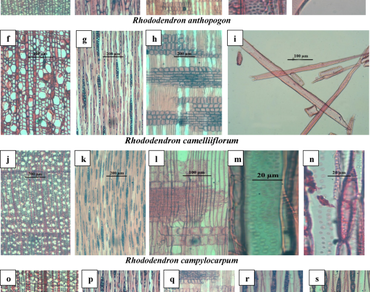
Rhododendron species namely R. anthopogon, R. camelliiflorum, R. campylocarpum, R. cinnabarinum, R. dalhousiae, R. falconeri, R. fulgens, R. grande, R. lanatum, R. thomsonii and R. wightii collected from West Kameng and Tawang districts, Arunachal Pradesh were taken to study the detailed anatomical features of selected shrub and tree species of Rhododendron of Arunachal Pradesh, India with reference to their ecological and phylogenetic implications. For each species, 5 wood samples were randomly collected at breast-height for trees and main stem internodes above base for shrubs. Wood anatomical characteristics of the selected species were homogeneous. In all the selected Rhododendron species, growth rings were distinct, and wood diffuse-porous except semi-ring porous wood in R. campylocarpum. Vessels were solitary and angular in outline, uniformly distributed, tube-shaped with tails, helical thickenings throughout vessel body except vessel tail of R. anthopogon and R. lanatum, tyloses absent except in R. camelliiflorum and R. thomsonii; scalariform perforation plates, inter-vessel pits opposite, minute-small in size and vessel-ray pits with distinct borders similar to inter-vessel pits. Fibres were small, thin-walled, bordered pits, occasionally septate and parenchyma paratracheal scanty, 2–5 cells/strand with simple pits. Rays were uniseriate, biseriate and multiseriate. Multiseriate rays had uniseriate wings on one/both ends. Homocellular rays were made up of upright/square cells, heterocellular rays were consisting of body ray cells procumbent and upright and/or square marginal cells, and disjunctive ray parenchyma cells. Fibre percentage was highest and parenchyma percentage was lowest in all the selected species. The selected species were well adapted to xerophytic conditions with low potential hydraulic conductivity and had primitive anatomical characters.
References
Baas P, Wheeler EA (2011) Wood anatomy and climate change. In: Hodkinson TR, Jones MB, Waldren S, Parnell JAN (eds) Climate change, ecology and systematics (Systematics Association Special Volume Series). Cambridge University Press, Cambridge, pp 141–155. https://doi.org/10.1017/CBO9780511974540.007
Beikircher B, Mayr S (2008) The hydraulic architecture of Juniperus communis L. ssp. communis: shrubs and trees compared. Plant Cell Environ 31(11):1545–1556. https://doi.org/10.1111/j.1365-3040.2008.01860.x
Bhan, S. C., Das, A. K., Saxena, R., Manik, S. K. (2023). Rainfall statistics of India–2022 (Technical Report No. MoES/IMD/HS/RAINFALL REPORT/02(2023)/62). India Meteorological Department, Ministry of Earth Sciences.
Bharali S, Khan ML (2012) Rhododendrons in Arunachal Pradesh, India. N Z Rhododendron Assoc Bull 100:81–85
Carlquist S (1977) Ecological factors in wood evolution: a floristic approach. Am J Bot 64(7):887–896. https://doi.org/10.2307/2442382
Carlquist S (1988) Comparative wood anatomy: systematic and evolutionary aspects of dicotyledon wood, 2nd ed. Springer
Carlquist S (1997) Wood anatomy of Buddlejaceae. Aliso 15:41–56
Carlquist S (2001) Comparative wood anatomy: systematic, ecological, and evolutionary aspects of dicotyledon wood. Springer
Chamberlain DF, Hyam R, Argent G, Fairweather G, Walter KS (1996) The genus Rhododendron: its classification and synonymy. Royal Botanic Garden Edinburgh
Clarke CB (1882) Ericaceae. In: Hooker JD (ed) Flora of British India, vol Vol. 3. L. Reeve & Co., pp 462–475
de Milleville R (2002) The rhododendrons of Nepal. Himal Books
Dickison WC (2000) Integrative plant anatomy. Academic Press
Franklin GL (1945) Preparation of thin sections of synthetic resins and wood-resin composites and a new macerating method for wood. Nature 155:51
Royal Botanic Gardens, Kew. (2026). Rhododendron L. In Plants of the World Online. Retrieved January 21, 2026, from https://powo.science.kew.org/taxon/urn:lsid:ipni.org:names:327085-2#children
Helmling S, Olbrich A, Heinz I, Koch G (2018) Atlas of vessel elements: Identification of Asian timbers. IAWA J 39(3):250–352
Hooker JD (1849) The rhododendrons of Sikkim-Himalaya: being an account, botanical and geographical of the rhododendrons recently discovered in the mountains of eastern Himalaya. Reeve & Co.
Hora B (1981) The Oxford encyclopaedia of trees of the world. Oxford University Press
Irving E, Hebda R (1993) Concerning the origin and distribution of rhododendrons. J Am Rhododendron Soc 47(3):139–162
Johansen DA (1940) Plant microtechnique. McGraw-Hill
Leach DG (1986) The ancient course revisited. Himalayan Plant J 4(9–10):69–72
Mennega AMW (1987) Wood anatomy of Euphorbiaceae in particular of subfamily Phyllanthoideae. Bot J Linn Soc 94:111–126. https://doi.org/10.1111/j.1095-8339.1987.tb01041.x
Merev N, Yavuz H (2000) Ecological wood anatomy of Turkish Rhododendron L. (Ericaceae): intraspecific variation. Turk J Bot 24:227–237
Noshiro S, Suzuki M (1995) Ecological wood anatomy of Nepalese Rhododendron (Ericaceae). II. Intraspecific variation. J Plant Res 108:217–233
Noshiro S, Suzuki M (2001) Ontogenetic wood anatomy of tree and subtree species of Nepalese Rhododendron (Ericaceae) and characterization of shrub species. Am J Bot 88(4):560–569
Noshiro S, Suzuki M, Ohba H (1995) Ecological wood anatomy of Nepalese Rhododendron (Ericaceae). I. Interspecific variation. J Plant Res 108:1–9
Noshiro S, Ikeda H, Joshi L (2010) Distinct altitudinal trends in the wood structure of Rhododendron arboreum (Ericaceae) in Nepal. IAWA J 31(4):443–456
Pathak ML, Shrestha BB, Joshi L, Gao XF, Jha PK (2018) Anatomy of two Rhododendron species along the elevational gradient, eastern Nepal. Banko Janakari 28(2):32–44
Paul A, Khan ML, Das AK (2010a) Utilization of rhododendrons by Monpas in western Arunachal Pradesh, India. J Am Rhododendron Soc 64(2):81–84
Paul A, Khan ML, Das AK, Dutta PK (2010b) Diversity and distribution of rhododendrons in Arunachal Himalaya, India. J Am Rhododendron Soc 64:200–205
Poorter L, McDonald I, Alarcón A, Fichtler E, Licona JC, Peña-Claros M, Sterck F, Villegas Z, Sass-Klaassen U (2010) The importance of wood traits and hydraulic conductance for the performance and life history strategies of 42 rainforest tree species. New Phytol 185(2):481–492
Rury PM (1985) Systematic and ecological wood anatomy of the Erythroxylaceae. IAWA Bull 6(4):365–397
Saenz-Romero C, Lamy JB, Loya-Rebollar E, Plaza-Aguilar A, Burlett R, Lobit P, Delzon S (2013) Genetic variation of drought-induced cavitation resistance among Pinus hartwegii populations from an altitudinal gradient. Acta Physiol Plant 35(10):2905–2913
Saikia P, Deka J, Bharali S, Kumar A, Tripathi OP, Singha LB, Dayanandan S, Khan ML (2017) Plant diversity patterns and conservation status of eastern Himalayan forests in Arunachal Pradesh, northeast India. Forest Ecosyst 4:28. https://doi.org/10.1186/s40663-017-0117-8
Suzuki, M., Noshiro, S., Takahashi, A., Terada, K., Yoda, K., Joshi, L. (1999). Wood structure of Himalayan plants III. In H. Ohba (Ed.), The Himalayan plants (Vol. 3). University Museum, University of Tokyo.
Suzuki M, Noshiro S (1988) Wood structure of Himalayan plants. In: Ohba H, Malla SB (eds) The Himalayan plants, vol Vol. 1. University of Tokyo Press, pp 341–379
Suzuki M, Ohba H (1988) Wood structural diversity among Himalayan Rhododendron. IAWA Bull 9(4):317–326
Tang Z, Zhai B, Wang G, Gessler A, Sun S, Hu Z (2023) Elevational variations in stem hydraulic efficiency and safety of Abies fabri. Funct Ecol 37(10):2570–2582. https://doi.org/10.1111/1365-2435.14408
Terzioğlu S, Merev N, Anşin R (2001) A study on Turkish Rhododendron L. (Ericaceae). Turk J Agric for 25:311–317
Thongdok NJ, Sati VP (2024) Impact of climate and soil on agriculture in West Kameng District, Arunachal Himalaya. Int Res J Multidiscipl Scope 5(4):1374–1385. https://doi.org/10.47857/irjms.2024.v05i04.01374
Tyree MT, Zimmermann MH (2002) Xylem structure and the ascent of sap. Springer. https://doi.org/10.1007/978-3-662-22627-8
Wang AY, Han SJ, Zhang JH, Wang M, Yin XH, Fang LD, Yang D, Hao GY (2018) The interaction between non-structural carbohydrate reserves and xylem hydraulics in Korean pine trees across an altitudinal gradient. Tree Physiol 38(12):1792–1804
Wangkhem M, Sharma M, Sharma CL, Momang T (2023) Physico-anatomical properties of Rhododendron arboreum Sm. subspecies of Arunachal Pradesh India. Indian J Hill Farm 23:162–172. https://doi.org/10.56678/iahf-spl36.2023.21
Wangkhem M, Sharma M, Sharma CL, Momang T, Niraj R (2024) Comparative anatomy of some Rhododendron species of Arunachal Pradesh, India. J Indian Acad Wood Sci 21(1):204–223. https://doi.org/10.1007/s13196-023-00326-x
Author Information
Department of Forestry, North Eastern Regional Institute of Science and Technology, Nirjuli, Itanagar, India