Vegetos

(An International Journal of Plant Research & Biotechnology)
Impact of temperature on growth and pathogenicity of fungi associated with grapevine trunk diseases in Iran
*Article not assigned to an issue yet
Ghasemi Esfahlan Saied, Shekariesfahlan Azam, Zare Rasoul, Hemmati Roghayeh, Khabbaz Jolfaee Hossein
Research Articles | Published: 23 December, 2025
First Page: 0
Last Page: 0
Views: 104
Keywords: GTDs, Esca, White rot, Disease severity, Climate change
Abstract
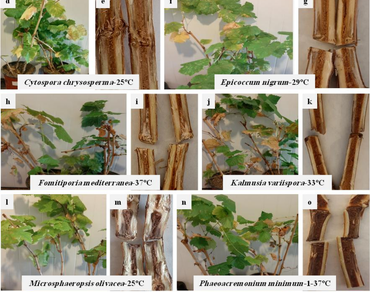
Grapevine trunk diseases (GTDs), exacerbated by the compounding effects of climate change, have led to significant economic losses globally, including in Iran. This study investigated the impact of various temperatures on the growth and pathogenicity of fourteen fungi isolated from diseased grapevine trunks. The study revealed a significant interaction effect between isolate and temperature on pathogenicity, with optimal growth temperatures (Topt) ranging from 20.0 to 27.5 °C, driving distinct patterns. Cytospora chrysosperma exhibited the highest growth at 25 °C (90 mm), followed by K. variispora (62.33 mm) and E. nigrum (37.67 mm). Phaeomoniella chlamydospora, Phaeoacremonium minimum, and Fomitiporia mediterranea exhibited peak canker lengths (up to 40.58 mm, 29.67 mm, and 26.08 mm, respectively) at 33–37 °C, while Microsphaeropsis olivacea declined at 37 °C (11.83 mm), is reflecting cooler adaptation. Moderate pathogens Kalmusia variispora and Cytospora chrysosperma peaked at 25–33 °C, and low-pathogenicity Epicoccum nigrum and Quambalaria sp. showed stability in different temperatures. The cumulative detrimental impacts of GTDs and abiotic factors, particularly heat stress, on grapevines are widely acknowledged. The findings of this study will help in enhancing region-specific GTD management strategies.
References
Abed-Ashtiani F, Narmani A, Arzanlou M (2019) Analysis of Kalmusia variispora associated with grapevine decline in Iran. Eur J Plant Pathol 154:787–799
Amborabé BE, Octave S, Roblin G (2005) Influence of temperature and nutritional requirements for mycelial growth of Eutypa lata, a vineyard pathogenic fungus. C R Biol 328:263–270
Andrade GCG, Alfenas AC, Mafia RG, Zauza EAV, Couto MMF, Maffia LA (2007) Características culturais e Severidade Da Mancha foliar de Quambalaria eucalypti Sob diferentes regimes de temperatura, Luz e período de Molhamento foliar. Fitopatol Bras 32:329–334
Arabnezhad M, Mohammadi H (2012) Study of Esca and petri disease of grapevine in Kerman Province. IJPP 48:277–283
Arzanlou M, Moshari S, Salari M, Badali H (2013) Molecular characterization and pathogenicity of Phaeoacremonium spp. Associated with Esca disease of grapevine in Northern Iran. Arch Phytopathol Plant Prot 46:375–388
Atlas Big (2024) https://www.atlasbig.com/en-gb/countries-by-grape-production
Bates D, Mächler M, Bolker B, Walker S (2015) Fitting linear mixed-effects models using lme4. J Stat Softw 67:1–48
Bolker BM, Brooks ME, Clark CJ, Geange SW, Poulsen JR, Stevens MH, White JS (2009) Generalized linear mixed models: a practical guide for ecology and evolution. Trends Ecol Evol 24:127–135
Brown KB, Hyde KD, Guest DI (1998) Preliminary studies on endophytic fungal communities of Musa acuminata species complex in Hong Kong and Australia. Fungal Divers 1:27–51
Christova PK, Slavov SB (2021) Epicoccum nigrum – isolation, characterization and potential for biological control of Botrytis cinerea. Bulg J Agric Sci 27:693–698
Cooney DG, Emerson R (1964) Thermophilic fungi: an account of their biology, activities, and classification. San Francisco u. W. H. Freeman and Comp, London. 188 pages
Dinno A (2017) Dunn.test: dunn’s test of multiple comparisons using rank sums. R package version 1.3.5
Edwards EJ, Smithson L, Graham DC, Clingeleffer PR (2011) Grapevine canopy response to a high-temperature event during deficit irrigation. Aust J Grape Wine R 17:153–161
FAO (2021) https://data.un.org/Data.aspx?d=FAO&f=itemCode%3A560
Fernandez O, Lemaître-Guillier C, Songy A, Robert-Siegwald G, Lebrun M-H, Schmitt-Kopplin P, Larignon P, Adrian M, Fontaine F (2023) The combination of both heat and water stresses May worsen Botryosphaeria dieback symptoms in grapevine. Plants 12:753
Fischer M (2002) A new wood-decaying basidiomycete species associated with Esca of grapevine: Fomitiporia mediterranea (Hymenochaetales). Mycol Prog 1:315–324
Ghasemi Esfahlan S, Hemmati R, Mohebbi S, Batley J, Arzanlou M (2022) Identification of endophytic fungi of grapevine with emphasis on the causal agents of grapevine trunk disease in the vineyards of Zanjan Province in Iran. Pathol 53:e12784
González-Domínguez E, Berlanas C, Gramaje D, Armengol J, Rossi V, Berbegal M (2020) Temporal dispersal patterns of Phaeomoniella chlamydospora, causal agent of petri disease and esca, in vineyards. Phytopathology 110:1216–1225
IPCC (2014) Climate change 2014: Synthesis report. In: Pachuri RK, Meyer LA (eds) Contribution of working groups I, II and III to the fifth assessment report of the intergovernmental panel on climate change. Geneva, Switzerland
Ji T, Salotti I, Altieri V, Li M, Rossi V (2023) Temperature-dependent growth and spore germination of fungi causing grapevine trunk diseases: quantitative analysis of literature data. Plant Dis 107:1386–1398
Jones GV, White MA, Cooper OR, Storchmann K (2005) Climate change and global wine quality. Clim Change 73:319–343
Karimi MR, Mahmoudi B, Kazemyain M (2001) First report of Esca of grapevine in Iran. Phytopathol Mediterr 40:481
Khaledi E, Moghadam JN, Abdollahzadeh J, Amini J (2021) Fungi associated with grapevine trunk diseases (GTDs) with emphasize on pestalotioid species in Kurdistan Province, Iran. Biol Res Squar https://doi.org/10.21203/rs.3.rs-192033/v1
Laveau C, Letouze A, Louvet G, Bastien S, Guerin-Dubrana L (2009) Differential aggressiveness of fungi implicated in Esca and associated diseases of grapevine in France. Phytopathol Mediterr 48:32–46
Lawrence DP, Travadon R, Pouzoulet J, Rolshausen PE, Wilcox WF, Baumgartner K (2017) Characterization of Cytospora isolates from wood cankers of declining grapevine in North America, with the descriptions of two new Cytospora species. Plant Pathol 66:713–725
Lenth RV (2021) emmeans: Estimated marginal means, aka least-squares means. R package version 1.7.0
Levene H (1960) Robust tests for equality of variances. In: Olkin I (ed) Contributions to probability and statistics. Stanford University Press, Palo Alto, pp 278–292
Lin L, Pan M, Bezerra JDP, Tian C, Fan X (2023) Re-evaluation of the fungal diversity and pathogenicity of Cytospora species from Populus in China. Plant Dis 107:83–96
Makris G, Sandoval-Denis M, Crous PW, Kanetis LI (2025) Kalmusia variispora (Didymosphaeriaceae, Dothideomycetes) associated with the grapevine trunk disease complex in Cyprus. Pathogens 14:428
Mohammadi H, Banihashemi Z (2007) Grapevine decline in Fars Province. IJPP 43:294–310
Mohammadi H, Banihashemi Z, Gramaje G, Armengol J (2013) Fungal pathogens associated with grapevine trunk diseases in Iran. JAST 15:137–150
Narmani A, Arzanlou M (2019) Quambalaria cyanescens, a new fungal trunk pathogen associated with grapevine decline in Iran. Crop Prot 124:104875
Narmani A, Arzanlou M, Babai–Ahari A (2014) Induction of sexual reproduction and determination of mating types in Phaeoacremonium aleophilum, the causal agent of Esca disease of grapevine in East Azerbaijan Province. IJPP 50:281–289
Paap T, Marincowitz S, Pham NQ, Roets F, Roets F, Basson RJ, Wingfield BD, Oberlander K, Wingfield MJ (2023) A novel species of Microsphaeropsis causing cankers on Rafnia amplexicaulis in South Africa. Fungal Syst Evol 12:73–80
Parmesan C, Yohe G (2003) A globally coherent fingerprint of climate change impacts across natural systems. Nature 421(6918):37–42
Pazooki S, Shekariesfahlan A, Maleki M, Naeimi S (2024) Isolation and identification of endophytic and grapevine trunk diseases associated fungi with antagonistic potential against Cytospora Chrysosperma. J Plant Pathol. https://doi.org/10.1007/s42161-024-01731-y
Pedregosa F, Varoquaux G, Gramfort A et al (2011) Scikit-learn: machine learning in python. J Mach Learn Res 12:2825–2830
Photita W, Lumyong S, Lumyong P, McKenzie EHC, Hyde KD (2004) Are some endophytes of Musa acuminata latent pathogens? Fungal Divers 16:131–140
Pitt WM, Huang R, Steel CC, Savocchia S (2013) Pathogenicity and epidemiology of botryosphaeriaceae species isolated from grapevines in Australia. Australas Plant Pathol 42:573–582
Pontini S, Fleurat-Lessard P, Béré E, Berjeaud JM, Roblin G (2014) Impact of temperature variations on toxic effects of the polypeptides secreted by Phaeoacremonium aleophilum. Physiol Mol Plant Pathol 87:51–58
Qiu Y, Steel CC, Ash GJ, Savocchia S (2016) Effects of temperature and water stress on the virulence of Botryosphaeriaceae spp. Causing dieback of grapevines and their predicted distribution using CLIMEX in Australia. Acta Hortic 1115:171–182
R Core Team (2023) R: A language and environment for statistical computing. R foundation for statistical computing, Vienna, Austria. Available online at https://www.R-project.org/
Rosso L, Lobry JR, Flandrois JP (1993) An unexpected correlation between Cardinal temperatures of microbial growth highlighted by a new model. J Theor Biol 162:447–463
Schulz B, Boyle C (2005) Review: the endophytic continuum. Mycol Res 109:661–686
Shapiro SS, Wilk MB (1965) An analysis of variance test for normality (Complete samples). Biometrika 52:591–611
Shekariesfahlan A, Karimishahri MR, Dehghani A, Mohammadipour M, Ravanlou A, Safaiefarahani B, Asgari B, Zare R, Ghalandar M (2025) Pathogenicity and aggressiveness of fungi associated with grapevine trunk diseases in Iran. Indian Phytopathol 78:591–601
Sieber T (2007) Endophytic fungi in forest trees: are they mutualists? Fungal Biol Rev 21:75–89
Slippers B, Wingfield MJ (2007) Botryosphaeriaceae as endophytes and latent pathogens of Woody plants: diversity, ecology and impact. Fungal Biol Rev 21:90–106
Songy A, Fernandez O, Clément C, Larignon P, Fon- taine F (2019) Grapevine trunk diseases under thermal and water stresses. Planta 249:655–1679
Spearman C (2010) The proof and measurement of association between two things. Int J Epidemiol 39:1137–1150
Urbez-Torres J (2011) The status of botryosphaeriaceae species infecting grapevines. Phytopathol Mediterr 50:5–45
Vaghari Souran SE, Shekariesfahlan A, Ashrafi F, Naeimi S, Ghasemi A (2023) Isolation and identification of grapevine endophytic bacteria with antagonistic potential against Fomitiporia mediterranea, a pathogen involved in grapevine trunk disease. J Plant Dis Prot 130:1371–1384
Valtaud C, Larignon P, Roblin G, Fleurat-Lessard P (2009) Developmental and ultrastructural features of Phaeomoniella Chlamydospora and Phaeoacremonium aleophilum in relation to xylem degradation in Esca disease of the grapevine. J Plant Pathol 91:37–51
Virtanen P, Gommers R, Oliphant TE et al (2020) SciPy 1.0: fundamental algorithms for scientific computing in python. Nat Methods 17:261–272
Author Information
Iranian Research Institute of Plant Protection, Agricultural Research, Education and Extension Organization (AREEO), Tehran,, Iran