Vegetos

(An International Journal of Plant Research & Biotechnology)
Drought stress responses in the germination; proximate composition, antioxidant and antidiabetic activities of Fava bean (Vicia faba L.) seeds grown in Manipur
*Article not assigned to an issue yet
Research Articles | Published: 16 March, 2026
First Page: 0
Last Page: 0
Views: 102
Keywords: Drought, n Vicia faba L., PEG 6000, Antioxidant, Antidiabetic
Abstract
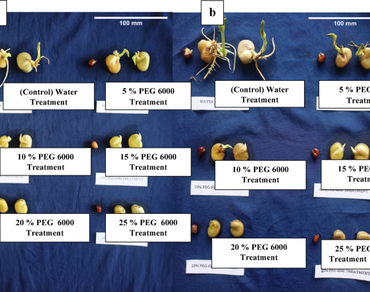
Drought stress is the prevailing and pervasive environmental challenge impeding agricultural practices and endangering crop productivity. The objective of the study is to determine the nutritional and stress tolerant capacity in three fava bean landraces of Manipur namely Pb-vf-24-1 (small seed), Pb-vf-24-2 (medium seed) and Pb-vf-24-3 (broad seed) which have been attributed due to its high content of protein, minerals, and antioxidant compounds. Drought was imposed in the germinating seedling for 15 days as the germination phase is the key period in examining stress mechanisms for variable tolerance potentiality to the PEG 6000 concentrations of 0% (control), 5%, 10%, 15%, 20%, and 25%, furnishing respective osmotic potentials of 0 MPa, −0.05 MPa, −0.15 MPa, −0.30 MPa, −0.49 MPa and, −0.73 MPa. Pb-vf-24-2 was exhibiting maximum tolerance while Pb-vf-24-1 was displaying minimum tolerance considering the germination parameters and Drought Tolerance Index (DTI). Proximate composition analysis elucidated a high-level percentage concentration of crude protein in Pb-vf-24-1 and the highest crude fiber percentage concentration in Pb-vf-24-2, rendering a good source of protein and fiber. The landraces also revealed potential antioxidant and antidiabetic activities with the IC₅₀ values of DPPH scavenging and α-amylase inhibitory activities ranging from 6–8 µg/mL and 8–14 µg/mL in comparison with the standard antioxidants, gallic acid (1.947 µg/mL), ascorbic acid (1.914 µg/mL) and standard inhibitor, acarbose (8.574 µg/mL) respectively. The high-level antioxidant activity was due to the moderately high values of phenolic and flavonoid contents in mg.GAE/g extracts and mg.QE/g extracts of the seed samples with the highest being shown by Pb-vf-24-2. Mineral contents of the seeds discovered that broad beans of Manipur were a good source of essential nutrient elements.
References
Abdel-Hady MS, EL-Naggar HMH (2007) Wheat genotypic variation and protein markers in relation with in vitro selection for drought tolerance. Res J Appl Sci 3(10):926–934
Ahanger MB, Tyaga SR, Wani MR, Ahmad P (2014) Drougth tolerance: role of organic osmolytes, growth regulators and mineral nutrients. Adv Agron 1:26. https://doi.org/10.1007/978-1-4614-8591-9_2
Aletan UI, Kwazo HA (2019) Analysis of the proximate composition, anti-nutrients and mineral content of Maerua crassifolia leaves. Nig J Basic Appl Sci 27(1):89–96. https://doi.org/10.4314/njbasv27i1.12
Alghamdi SS (2009) Chemical composition of Faba bean (Vicia Faba L.) genotypes under various water regimes. Pak J Nutr 8(4):477–482. https://doi.org/10.3923/pjn.2009.477.482
Al-Karaki GN (1998) Seed size and water potential on water uptake, germination and growth of lentil. J Agron Crop Sci 181:237–242. https://doi.org/10.1111/j.1439-037X.1998.tb00423.x
Altaf A et al (2021) Study of the effect of PEG-6000 imposed drought stress on wheat (Triticum aestivum L.) cultivars using relative water content (RWC) and protein content analysis. Pak J Agri Sci 5(8):357–367. https://doi.org/10.21162/PAKJAS/21.953
Amelia VD, Aversano R, Chiaiese P, Carputo D (2018) The antioxidant properties of plant flavonoids: their exploitation by molecular plant breeding. Phytochem Rev 17(3):611–625. https://doi.org/10.1007/s11101-018-9568-y
Ashraf Zu, Gani A, Shah A, Gani A (2024) Identification of antidiabetic peptides from broad bean protein: sequencing using LC-MS-QTOF and in-vitro confirmative studies. Food Biosci 61:104903. https://doi.org/10.1016/j.fbio.2024.104903
Aune D, Chan DSM, Lau R, Vieira R, Greenwood DC, Kampman E, Norat T (2011) Dietary fibre, whole grains, and risk of colorectal cancer: systematic review and dose-response meta-analysis of prospective studies. BMJ 343:6617. https://doi.org/10.1136/bmj.d6617
Babu PVA, Liu D, Gilbert ER (2013) Recent advances in Understanding the antidiabetic actions of dietary flavonoids. J Nutr Biochem 24(11):1777–1789. https://doi.org/10.1016/j.jnutbio.2013.06.003
Barris HD, Weatherley PE (1962) A re-examination of the relative turgidity technique for estimating water deficits in leaves. Aust J Biol Sci 15(3):413–428. https://doi.org/10.1071/bi9620413
Belachew KY, Nagel KA, Poorter H, Stoddard FL (2019) Association of shoot and root responses to water deficit in young Faba bean (Vicia Faba L.) plants. Front Plant Sci 10:1063
Brand-Williams W, Cuvelier ME, Berset C (1995) Use of a free radical method to evaluate antioxidant activity. Food Sci Technol 28(1):25–30. https://doi.org/10.1016/S0023-6438(95)80008-5
Campos-Vega R, Loarca-Pina G, Oomah BD (2010) Minor components of pulses and their potential impact on human health. Food Res Int 43(2):461–482. https://doi.org/10.1016/j.foodres.2009.09.004
Choi Y, Jeong H-S, Lee J (2007) Antioxidant activity of methanolic extracts from some grain consumed in Korea. Food Chem 103(1):130–138. https://doi.org/10.1016/j.foodchem.2006.08.004
Clemente A, Olias R (2017) Beneficial effects of legumes in gut health. Curr Opin Food Sci 14:32–36. https://doi.org/10.1016/j.cofs.2017.01.005
Debnath P, Debnath P, Roy S, Devi MB, Devi MM, Sarangthem K, Singh SS, Roy M, Novikov AS, Misra TK (2024) Azo-benzoic acid derivatives directed dinuclear and tetranuclear association of Trimethyltin (IV) complex components and their biological activities. Inorg Chim Acta 559:121805. https://doi.org/10.1016/j.ica.2023.121805
Gajula D, Verghese M, Boateng J, Walker LT, Shackelford L, Mentreddy SR, Cedric S (2009) Determination of total phenolics, flavonoids and antioxidant and chemopreventive potential of Basil (Ocimum Basilicum L. and Ocimum tenuiflorum). Int J Cancer Res 5(4):130–143. https://doi.org/10.3923/ijcr.2009.130.143
Ganesan K, Xu B (2017) Polyphenol-rich dry common beans (Phaseolus vulgaris L.) and their health benefits. Int J Mol Sci 18(11):2331. https://doi.org/10.3390/ijms18112331
Gharibzahedi SMT, Monsavi SM, Jafari SM, Faraji K (2012) Proximate composition, mineral content, and fatty acid profile of two varieties of lentil seeds cultivated in Iran. Chem Nat Compd 47(6):976–978. https://doi.org/10.1007/s10600-012-0119-2
Gharoobi B (2011) Effects of seed size on seedlings characteristics of five barley cultivars. Iran J Plant Physiol 1(4):265–270
Hansawasdi C, Kawabata J, Kasai T (2000) α-Amylase inhibitors from roselle (Hibiscus Sabdariffa Linn.) tea. Biosci Biotech Bioch 64(5):1041–1043. https://doi.org/10.1271/bbb.64.1041
Hewavitharana GG, Perera DN, Navaratne SB, Wickramasinghe I (2020) Extraction methods of fat from food samples and Preparation of fatty acid Methyl esters for gas chromatography: a review. Arab J Chem 13(8):6865–6875. https://doi.org/10.1016/j.arabjc.2020.06.039
Kapoor D, Bhardwaj S, Landi M, Sharma A, Ramakrishnan M, Sharma A (2020) The impact of drought in plant metabolism: how to exploit tolerance mechanisms to increase crop production. Appl Sci 10(16):5692. https://doi.org/10.3390/app10165692
Khamassi K, Harbaoui K, Teixeira da Silva JA, Jeddi FB (2013) Optimal germination temperature assessed by indices and models in field bean (Vicia Faba L. var. minor). Agric Conspec Sci 78(2):131–136
Khazaei H, Vandenberg A (2020) Seed mineral composition and protein content of Faba beans (Vicia Faba L.) with contrasting tannin contents. Agronomy 10(4):511. https://doi.org/10.3390/agronomy10040511
Khodarahmpour Z (2011) Effect of drought stress induced by polyethylene glycol (PEG) on germination indices in corn (Zea Mays L.) hybrids. Afr J Biotechnol 10(79):18222–18227. https://doi.org/10.5897/AJB11.2639
Kumar et al (2022) A brief overview of the biological activities of Faba bean (Vicia Faba). Forage Res 48(2):152–160
Kumar V, Poonia RC, Chaudhary K (2018) Assessment of the seed vigour potential in different varieties of wheat. Int J Curr Microbiol App Sci 7(7):354–361. https://doi.org/10.20546/ijcmas.2018.707.043
Kumari SG, Van Leur JAG (2011) Viral diseases infecting Faba bean (Vicia Faba L). In: Rubiales D (ed) Grain legumes. Cordoba, Spain, pp 24–26
Labba I-CM, Frokiaer H, Sandberg A-S (2021) Nutritional and antinutritional composition of Fava bean (Vicia Faba L., var. minor). Food Res Int 140:110038. https://doi.org/10.1016/j.foodres.2020.110038
Leist N, Kramer S, Jonitz A (eds) (2003) ISTA working sheets on tetrazolium testing: agricultural, vegetable and horticultural species. International Seed Testing Association, Bassersdorf, Switzerland
Li CL, Yu SY, Lu Y (2019) Study on extraction of dietary fiber from potato Peel by acid-base chemical method. Environ Earth Sci 267:052028. https://doi.org/10.1088/1755-1315/267/5/052028
Maiti RK, Amaya LED, Cardona SI, Dimas AMO, Rosa-Ibarra MDL, Castillo HDL (1996) Genotypic variability in maize cultivars (Zea Mays L.) for resistance to drought and salinity at the seedling stage. J Plant Physiol 148(6):741–744. https://doi.org/10.1016/s0176-1617(96)80377-4
Maiti RK, Rosa-Ibarra MDL, Sandoval ND (1994) Genotypic variability in glossy sorghum lines for resistance to drought, salinity and temperature stress at the seedling stage. J Plant Physiol 143(2):241–244. https://doi.org/10.1016/S0176-1617(11)81694-9
Meneses CHSG, Bruno RLA, Fernandes PD, Pereira WE, Lima LHGM, Lima MMA, Vidal MS (2011) Germination of cotton cultivar seeds under water stress induced by polyethyleneglycol-6000. Sci Agric 68(2):131–138. https://doi.org/10.1590/S0103-90162011000200001
Mian MAR, Nafziger ED (1994) Seed size and water potential effects on germination and seedling growth of winter wheat. Crop Sci 34(1):169–171. https://doi.org/10.2135/cropsci1994.0011183X003400010030x
Michel BE, Kaufmann MR (1973) The osmotic potential of polyethylene glycol 6000. Plant Physiol 51(5):914–916. https://doi.org/10.1104/pp.51.5.914
Millar KA, Gallagher E, Burke R, McCarthy S, Barry-Ryan C (2019) Proximate composition and anti-nutritional factors of fava-bean (Vicia faba), green-pea and yellow-pea (Pisum sativum) flour. J Food Compos Anal 82:103233. https://doi.org/10.1016/j.jfca.2019.103233
Mohamed HI, Akladious SA, Ashry NA (2018) Evaluation of water stress tolerance of soybean using physiological parameters and retrotransposon-based markers. Gesunde Pflanzen 70:205–215. https://doi.org/10.1007/s10343-018-0432-1
Mujtaba SM, Faisal S, Khan MA, Mumtaz S, Khanzada B (2016) Physiological studies on six wheat (Triticum aestivum L.) genotypes for drought stress tolerance at seedling stage. Agric Sci Technol 1(2):1–5. https://doi.org/10.19080/ARTOAJ.2016.01.555559
Nowsherwan I, Shabbir G, Malik SI, Ilyas M, Cheema NM (2017) Selection of wheat genotype(s) for drought stress based on physiological traits. Int J Plant Soil Sci 17(3):1–7. https://doi.org/10.9734/IJPSS/2017/33720
Prabhu DS, Rajeshwari VD (2018) Nutritional and biological properties of Vicia Faba L.: a perspective review. Int Food Res J 25(4):1332–1340
Premachandra GS, Shimada T (1987) The measurement of cell membrane stability using polyethylene glycol as a drought tolerance test in wheat. Jpn Jour Crop Sci 56(1):92–98. https://doi.org/10.1626/jcs.56.92
Qayyum MMN, Butt MS, Anjum FM, Nawaz H (2012) Composite analysis of some selected legumes for protein isolates recovery. J Anim Plant Sci 22(4):1156–1162
Radhi IM, Hussein HT (2022) Effect of mannitol and PEG induced water stress on seedling growth of broad bean (Vicia Faba L). Int J Agricult Stat Sci 18(1):1805–1810
Rauf S, Sadaqat HA, Khan IA (2008) Effect of moisture regimes on combining ability variations of seedling traits in sunflower (Helianthus annuus L). Can J Plant Sci 88(2):323–329. https://doi.org/10.4141/CJPS07036
Ries SK, Everson EH (1993) Protein content and seed size relationships with seedling vigour of wheat cultivars. Agron J 65(6):884–886. https://doi.org/10.2134/agronj1973.00021962006500060011x
Rizkalla SW, Bellisle F, Slama G (2002) Health benefits of low glycaemic index foods, such as pulses, in diabetic patients and healthy individuals. Br J Nutr 88(3):255–262. https://doi.org/10.1079/BJN2002715
Sharma KR, Giri G (2022) Quantification of phenolic and flavonoid content, antioxidant activity, and proximate composition of some legume seeds grown in Nepal. Int J Food Sci. https://doi.org/10.1155/2022/4629290
Singh AK, Bharati RC, Manibhushan NC, Pedpati A (2013) An assessment of Faba bean (Vicia Faba L.) current status and future prospect. Afr J Agric Res 8(50):6634–6641. https://doi.org/10.5897/AJAR2013.7335
Tamindzic G, Cervenski J, Milosevic D, Vlajic S, Nikolic Z, Ignjatov M (2021) The response of garden pea cultivars to stimulated drought. Acta Agric Serb 26(52):167–173. https://doi.org/10.5937/AASer2152167T
Tandon HSL (ed) (2009) Methods of analysis of soils, plants, waters, fertilizers and organic manures. Fertiliser Development and Consultation Organisation, New Delhi, India, pp 204 + xii
Turco I, Ferretti G, Bacchetti T (2016) Review of the health benefits of Faba bean (Vicia Faba L.) polyphenols. Food Nutr Res 55(4):283–293
Willenborb CJ, Gulden RH, Jhonson EN, Shirtliffe SJ (2004) Germination characteristics of polymer-coated Canola (Brassica Napus L.) seeds subjected to moisture stress at different temperatures. Agron J 96(3):786–791. https://doi.org/10.2134/AGRONJ2004.0786
Xie J, Schaich KM (2014) Re-evaluation of the 2,2-diphenyl-1-1-picrylhydrazyl free radical (DPPH) assay for antioxidant activity. J Agric Food Chem 62(19):4251–4260. https://doi.org/10.1021/jf500180u
Zhang L, Gao M, Hu J, Zhang X, Wang K, Ashraf M (2012) Modulation role of abscisic acid (ABA) on growth, water relations and Glycinebetaine metabolism in two maize (Zea Mays L.) cultivars under drought stress. Int J Mol Sci 13(3):3189–3202. https://doi.org/10.3390/ijms13033189
Author Information
Department of Life Sciences (Botany), Manipur University, Canchipur, India