Vegetos

(An International Journal of Plant Research & Biotechnology)
(eISSN: 2229-4473)
Enhanced production of withanolide A in Agrobacterium rhizogenes-induced hairy root cultures of Withania somnifera (L.) Dunal compared to in vitro roots
*Article not assigned to an issue yet
Nadaf Jafar Fakirasab, Nishani Sandhyarani, Narayanapur Vijayakumar B., Naik N. Jayarama, Chandalinga
Research Article | Published: 07 August, 2026
First Page: 0
Last Page: 0
Views: 19
Keywords: Hairy root culture, Withanolide A, n Agrobacterium rhizogenesn , In vitro biotechnology, n Withania somniferan
Abstract
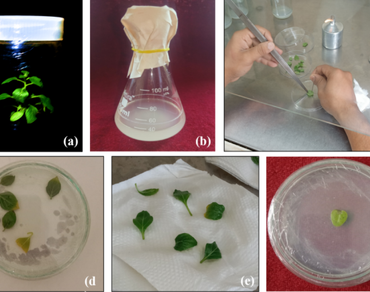
Withania somnifera (L.) Dunal is a medicinally important plant recognized for its pharmacologically valuable withanolides, particularly withanolide A. However, conventional cultivation and non-transformed in vitro root cultures often exhibit limited and inconsistent metabolite accumulation. The present study aimed to establish Agrobacterium rhizogenes-mediated hairy root cultures and comparatively evaluate withanolide A production in transformed hairy roots and non-transformed in vitro roots. Hairy roots were induced from in vitro-grown leaf explants using A. rhizogenes strain MTCC 532 under optimized transformation conditions. The transformed roots exhibited characteristic hormone-independent growth, profuse lateral branching and rapid proliferation. Molecular confirmation by PCR amplification of the rolC gene verified stable integration of Ri T-DNA into the transformed root genome. Quantitative analysis using high-performance liquid chromatography (HPLC) demonstrated significantly higher withanolide A accumulation in hairy root cultures (0.880 mg g− 1 DW) than in non-transformed in vitro roots (0.162 mg g− 1 DW), representing an approximately 5.4-fold increase. The enhanced metabolite accumulation is likely associated with Ri T-DNA-mediated transformation and the altered metabolic activity of hairy root cultures. The findings demonstrate that A. rhizogenes-induced hairy root cultures provide a stable and efficient platform for improving withanolide A production in W. somnifera. This study establishes an optimized transformation protocol and provides a comparative evaluation of transformed hairy roots and non-transformed in vitro roots, highlighting the potential of hairy root biotechnology for sustainable production of valuable withanolides and future metabolic engineering applications.
References
Ahmad Z, Shareen, Ganie IB, Firdaus F, Ramakrishnan M, Shahzad A, Ding Y (2024) Enhancing withanolide production in the Withania species: advances in in vitro culture and synthetic biology approaches. Plants 13:2171
Akerele O, Heywood V, Synge H (1991) Conservation of medicinal plants. Cambridge University Press, Cambridge
Balandrin MF, Klocke JA, Wurtele ES, Bollinger WH (1985) Natural plant chemicals: sources of industrial and medicinal materials. Science 228:1154–1160
Chen SL, Yu H, Luo HM, Wu Q, Li CF, Steinmetz A (2016) Conservation and sustainable use of medicinal plants: problems, progress and prospects. Chin Med 11:37
George EF, Hall MA, De Klerk GJ (2008) Plant propagation by tissue culture, 3rd edn. Springer, Dordrecht
Giri A, Narasu ML (2000) Transgenic hairy roots: recent trends and applications. Biotechnol Adv 18:1–22
Hakim SE, Choudhary N, Malhotra K, Peng J, Bültemeier A, Arafa A, Friedhoff R, Bauer M, Eikenberg J, Witte CP, Herde M, Heretsch P, Pucker B, Franke J (2025) Phylogenomics and metabolic engineering reveal a conserved gene cluster in Solanaceae plants for withanolide biosynthesis. Nat Commun 16:6367
Halder T, Ghosh B (2024) Withania somnifera (L.) Dunal: Enhanced production of withanolides and phenolic acids from hairy root culture after application of elicitors. J Biotechnol 388:59–71
Karami M, Naghavi MR, Nasiri J, Farzin N, Ignea C (2024) Enhanced production of withaferin A from the hairy root culture of Withania somnifera via synergistic effect of methyl jasmonate and β-cyclodextrin. Plant Physiol Biochem 208:108440
Murthy HN, Dandin VS, Paek KY (2014) Strategies for enhanced production of plant secondary metabolites from hairy root cultures. Biotechnol Adv 32:1226–1243
Murthy HN, Georgiev MI, Kim YS, Paek KY (2008) Hairy root cultures for the production of secondary metabolites. Plant Cell Tissue Organ Cult 94:1–22
Rout GR, Samantaray S, Das P (2000) In vitro manipulation and propagation of medicinal plants. Biotechnol Adv 18:91–120
Sambrook J, Russell DW (2001) Molecular cloning: A laboratory manual, 3rd edn. Cold Spring Harbor Laboratory Press, New York
Sivanandhan G, Kapil Dev G, Jeyaraj M, Rajesh M, Arjunan A, Muthuselvam M, Manickavasagam M, Selvaraj N, Ganapathi A (2013) Increased production of withanolide A, withanone, and withaferin A in hairy root cultures of Withania somnifera (L.) Dunal elicited with methyl jasmonate and salicylic acid. Planr Cell Tissue Organ Cult 114:121–129
Thilip C, Mehaboob VM, Varutharaju K, Faizal K, Raja P, Aslam A, Shajahan A (2019) Elicitation of withaferin-A in hairy root culture of Withania somnifera (L.) Dunal using natural polysaccharides. Biologia 74:961–968
Thorat SA, Kaniyassery A, Poojari P, Rangel M, Tantry S, Kiran KR, Joshi MB, Rai PS, Botha AM, Muthusamy A (2022) Differential gene expression and withanolides biosynthesis during in vitro and ex vitro growth of Withania somnifera (L.) Dunal. Front Plant Sci 13:917770
Panse VG, Sukhatme PV (1967) Statistical methods for agricultural workers, 2nd edn. Indian Council of Agricultural Research, New Delhi
Author Information
Department of Plantation, Spices, Medicinal and Aromatic Crops (PSMA), College of Horticulture, Bagalkot, University of Horticultural Sciences, Bagalkot, India