Vegetos

(An International Journal of Plant Research & Biotechnology)
(eISSN: 2229-4473)
Optimization of in vitro culture in Plantago lanceolata using plant growth regulators and evaluation of biocompatibility and toxicity against Artemia salina
*Article not assigned to an issue yet
Research Articles | Published: 12 August, 2026
First Page: 0
Last Page: 0
Views: 4
Keywords: Brine shrimp, Callus formation, Hemolysis degree, Regeneration, Shoot organogenesis, n Plantago lanceolatan
Abstract
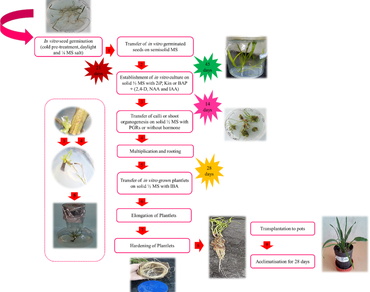
Plantago lanceolata L., a medicinal plant of the family Plantaginaceae, possesses considerable therapeutic potential. This study aimed to establish an efficient in vitro regeneration system for P. lanceolata and to evaluate the toxicity of methanolic extracts obtained from regenerated plantlets. Callus induction and shoot organogenesis were investigated using half-strength Murashige and Skoog (½MS) medium supplemented with different combinations of cytokinins, including Kinetin (Kin), 6-(γ,γ-Dimethylallylamino) Purine (2iP), and 6-Benzylaminopurine (BAP) in combination with auxins such as Indole-3-acetic acid (IAA), α-Naphthaleneacetic acid (NAA), and 2,4-Dichlorophenoxyacetic acid (2,4-D). Hemolysis and toxicity assays of the regenerated plantlets were evaluated. Maximum callus formation (100%) was simultaneously obtained by 2iP (1.0 or 2.0 mg/L) plus NAA (1.5 mg/L) and BAP (0.0 or 1.0 mg/L) with 2,4-D (0.5 or 1.5 mg/L) in shoot and root explants. The highest shoot organogenesis was observed with 2.0 mg/L 2iP and 0.5 mg/L NAA (62% and 100%), 2.0 mg/L Kin + 1.0 mg/L IAA (54% and 100%) and 1.5 mg/L BAP alone (83.33% and 100%) in leaf and root explants. The maximum number of shoots was recorded with 2 mg/L 2iP and 0.5 mg/L NAA (22.33 and 15.67 shoots), and 1.5 mg/L BAP (21.33 and 25.33 shoots) in leaf and root explants, respectively. Regenerated shoots were successfully rooted either without or with 0.5 mg/L indole-3-butyric acid, and plantlets were hardened with 100% survival. Toxicity assays showed that methanolic extracts of regenerated plantlets induced less than 1% hemolysis and no lethality in Artemia salina nauplii at 100 µg/mL, indicating no detectable toxicity. The results demonstrated optimized regeneration protocols and confirmed the bioactivity of regenerated plantlets, providing a foundation for future research on the pharmaceutical applications of P. lanceolata derived from tissue culture.
References
Amininasab SS, Otaghvari AM, Nazifi E (2021) Phytochemical study of Plantago major and Plantago lanceolata in north of Iran. Appl Biol Res 35(3):9–26
Andrzejewska-Golec E, Makowczynska J (2008) Micropropagation of Plantago camtschatica link. Acta Soc Bot Pol 77(4):269–273
Arikat NA, Jawad FM, Khamouzaram NS, Shibli RA (2004) Micropropagation and accumulation of essential oils in wild sage (Salvia fruticosa Mill.). Sci Hortic 100(14):193–202. https://doi.org/10.1016/j.scienta.2003.07.006
Benniamin A, Manickam VS, Johnson M, Joseph LH (2004) Micropropagation of Crataeva magna (Lour.) DC-A medicinal plant. Indian J Biotechnol (IJBT) 3(1):136–138
Budzianowska A, Skrzypczak L, Budzianowski J (2004) Phenylethanoid glucosides from in vitro propagated plants and callus cultures of Plantago lanceolata. Planta Med 70(9):834–840. https://doi.org/10.1055/s-2004-827232
Chen X, Qu Y, Sheng L, Liu J, Huang H, Xu L (2014) A simple method suitable to study de novo root organogenesis. Frontiers Plant Sci 15(5):208. https://doi.org/10.3389/fpls.2014.00208
Dalar A, Konczak I (2013) Phenolic contents, antioxidant capacities and inhibitory activities against key metabolic syndrome relevant enzymes of herbal teas from Eastern Anatolia. Ind Crop Prod 44:383–390. https://doi.org/10.1016/j.indcrop.2012.11.037
Debnath M, Malik CP, Bisen PS (2006) Micropropagation: a tool for the production of high quality plant-based medicines. Curr Pharm Biotechnol 7(1):33–49
Doğan M (2022) Influence of different concentrations of Murashige and Skoog medium on multiple shoot regeneration of Staurogyne repens (Nees) Kuntze. JETAS 7(1):61–67
George EF, Hall MA, De Klerk GJ (2008) Plant Propagation by Tissue Culture, 3rd edn. Springer
Gonçalves S, Martins N, Romano A (2009) Micropropagation and conservation of endangered species Plantago algarbiensis and P. almogravensis. Biol Plant 53(4):774. https://doi.org/10.1007/s10535-009-0142-8
Janković T, Zdunić G, Beara I, Balog K, Pljevljakušić D, Stešević D, Šavikin K (2012) Comparative study of some polyphenols in Plantago species. Biochem Syst Ecol 42:69–74. https://doi.org/10.1016/j.bse.2012.02.013
Khawar KM, Sarıhan EO, Sevımay CS, Çöçü S, Parmaksız I, Uranbey SE, Ipek A, Kaya MD, Sancak CE, Özcan S (2005) Adventitious shoot regeneration and micropropagation of Plantago lanceolata L. Period Biol 107(1):113–116
Makowczynska J, Andrzejewska-Golec E (2003) Micropropagation of Plantago asiatica L. through culture of shoot-tips. Acta Soc Bot Pol 72(3):191–194
Makowczynska J, Andrzejewska-Golec E (2009) Micropropagation of Plantago maritima L.—a vanishing species in Poland. Acta Soc Bot Pol 78(1):13–18
Omer E, Elshamy AI, Nassar M, Shalom J, White A, Cock IE (2019) Plantago squarrosa Murray extracts inhibit the growth of some bacterial triggers of autoimmune diseases: GC–MS analysis of an inhibitory extract. Inflammopharmacology 27:373–385. https://doi.org/10.1007/s10787-018-0547-0
Pramanik S, Chakraborty S, Raychaudhuri SS (1995) In vitro clonal propagation and characterization of clonal regenerants of Plantago ovata Forssk by isozyme analysis. Cytobios 82(329):123–130
Rajabi S, Ramazani A, Hamidi M, Naji T (2015) Artemia salina as a model organism in toxicity assessment of nanoparticles. Daru J Pharm Sci 23(1):20. https://doi.org/10.1186/s40199-015-0105-x
Rahamouz-Haghighi S, Bagheri K, Danafar H, Sharafi A (2020) Tissue culture, in vitro organogenesis and regeneration of Plantago lanceolata. JABR 7(4):258–265. https://doi.org/10.30491/jabr.2021.122254
Rahamouz-Haghighi S, Bagheri K, Danafar H, Sharafi A (2021) Anti-proliferative properties, biocompatibility, and chemical composition of different extracts of Plantago major medicinal plant. Iran Biomed J 25(2):106
Rahamouz-Haghighi S, Bagheri K, Sharafi A, Tavakolizadeh M, Mohsen-Pour N (2022) Phytochemical screening and cytotoxicity assessment of Plantago lanceolata L. root extracts on colorectal cancer cell lines and brine shrimp larvae and determination of the median lethal dose in mice. S Afr J 149:740–747. https://doi.org/10.1016/j.sajb.2022.06.058
Rahamouz-Haghighi S, Sharafi A (2023) Antiproliferative assay of suma or Brazilian ginseng (Hebanthe eriantha) methanolic extract on HCT116 and 4T1 cancer cell lines, in vitro toxicity on Artemia salina larvae, and antibacterial activity. Nat Prod Res 38(11):1850–1854. https://doi.org/10.1080/14786419.2023.2225688
Rahamouz-Haghighi S, Sharafi A (2024) Biocompatibility, cytoxicity and phytochemical analysis of Plantago lanceolata L. aerial extracts In vitro and In vivo study. EJMR. 11(1):8–24
Rathore MS, Rathore MS, Shekhawat NS (2013) Ex vivo implications of phytohormones on various in vitro responses in Leptadenia reticulata (Retz.) Wight. & Arn.—an endangered plant. Environ Exp Bot 86:86–93. https://doi.org/10.1016/j.envexpbot.2010.05.009
Ruebhart DR, Wickramasinghe W, Cock IE (2009) Protective efficacy of the antioxidants vitamin E and Trolox against Microcystis aeruginosa and microcystin-LR in Artemia franciscana nauplii. J Toxicol Environ Health A 72(24):1567–1575
Sæbø IP, Bjørås M, Franzyk H, Helgesen E, Booth JA (2023) Optimization of the hemolysis assay for the assessment of cytotoxicity. Int J Mol Sci 24(3):2914. https://doi.org/10.3390/ijms24032914
Salem J, Hassanein A, El-Wakil DA, Loutfy N (2022) Interaction between growth regulators controls in vitro shoot multiplication in Paulownia and selection of NaCl-tolerant variants. Plants 11(4):498
Sanna F, Piluzza G, Campesi G, Molinu MG, Re GA, Sulas L (2022) Antioxidant contents in a mediterranean population of Plantago lanceolata L. exploited for quarry reclamation interventions. Plants 11(6):791. https://doi.org/10.3390/plants11060791
Sarihan EO, Khawar MD, Özcan S (2005) Prolific adventitious shoot regeneration from black psyllium (Plantago afra L.). Gen Appl Plant Physiol 31(1–2):81–87
Shaik S, Goordiyal K, Watt MP (2018) The effects of micropropagation, acclimatisation substrate and physiological age on the growth and Ca and Fe content of selected Solanum nigrum genotypes. S Afr J Bot 118:192–202
Shekhawat MS, Kannan N, Manokari M, Ramanujam MP (2014) An efficient micropropagation protocol for high-frequency plantlet regeneration from liquid culture of nodal tissues in a medicinal plant. Turnera Ulmifolia l J Sustain for 33(4):327–336. https://doi.org/10.1080/10549811.2013.847793
Shekhawat MS, Kannan N, Manokari M, Ravindran CP (2015) In vitro regeneration of shoots and ex vitro rooting of an important medicinal plant Passiflora foetida L. through nodal segment cultures. J Genet Eng Biotechnol 13(2):209–214. https://doi.org/10.1016/j.jgeb.2015.08.002
Shekhawat MS, Shekhawat NS (2011) Micropropagation of Arnebia hispidissima (Lehm). DC. and production of alkannin from callus and cell suspension culture. Acta Physiol Plant 33(4):1445–1450. https://doi.org/10.1007/s11738-010-0680-x
Author Information
Agricultural Research, Education and Extension Organization (AREEO), Mashhad, Iran