Vegetos

(An International Journal of Plant Research & Biotechnology)
(eISSN: 2229-4473)
Integrative taxonomic approach to identify Piper longum morphotypes and Piper sarmentosum in Sri Lanka for standardization in ayurvedic medicine
*Article not assigned to an issue yet
Sawbhagya H. G. P., Jeewandara M. P., Kaluthanthri D. V. S., Senanayake R. A. S. P.
Research Articles | Published: 30 March, 2026
First Page: 0
Last Page: 0
Views: 29
Keywords: Adulteration, Molecular identification, Morphological characters, Morphotypes, n Piper longumn , n Piper sarmentosumn
Abstract
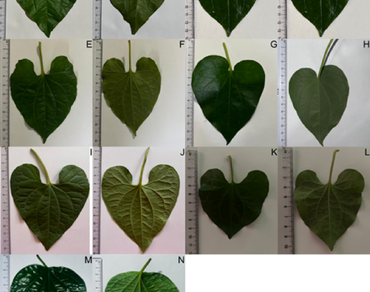
Piper is the largest genus in the family Piperaceae. Both Piper longum L. and Piper sarmentosum Roxb. are widely used in traditional medicine with P. longum holding greater economic value, but their morphological similarity often leads to misidentification. P. longum, native to Sri Lanka, is economically valuable but largely imported, with no commercial cultivation. Conservation of wild P. longum genotypes is essential before large-scale cultivation. Notably, P. longum shows significant morphological variation and rare male plants in Sri Lanka, unlike P. sarmentosum, suggesting possible subspecies or natural hybrids. The present study aims to achieve accurate species identification of P. longum and P. sarmentosum. In this study, specimens exhibiting slight morphological differences but phenotypic similarity to P. longum (PL) were collected from six localities. In addition, one specimen phenotypically resembling P. sarmentosum (PS) was collected. A phenogram and a Principal Component Analysis (PCA) biplot were constructed using thirteen morphological characters. For molecular identification, genomic DNA was extracted from leaves and ITS region amplification followed by sequencing (Macrogen Inc., Korea) was performed and a neighbor joining phylogenetic tree was constructed. Quantitative morphological analysis revealed that PS exhibited significantly larger leaf dimensions (leaf length: 13.51 ± 1.21 cm; leaf width: 11.34 ± 1.01 cm; leaf area: 111.32 ± 19.65 cm²) compared with PL specimens, which showed smaller leaf dimensions within the ranges of leaf length 6.88 ± 0.70 to 10.04 ± 1.01 cm, leaf width 6.78 ± 0.64 to 8.41 ± 0.83 cm, and leaf area 35.16 ± 7.26 to 53.00 ± 9.76 cm². The phenogram and PCA revealed that PL specimens and PS specimens have considerable distinct characteristics interpreting they may be two species and PL specimens are morphotypes differing notably in leaf shape, color, and spike traits, suggesting they may represent varieties or subspecies. Phylogenetic analysis confirmed that specimens from six localities belong to P. longum and that are morphotypes within this species with one specimen identified as P. sarmentosum. These findings offer valuable insights for conserving P. longum in Sri Lanka. Protecting economically important native species preserves genetic diversity and supports the economy, while requiring careful ecosystem management.
References
Chanchal C, Thongam B, Handique PJ (2015) Morphological diversity and characterization of some of the wild Piper species of North East India. Genet Resour Crop Evol 62(2):303–313. https://doi.org/10.1007/s10722-014-0172-8
Chaveerach A, Mokkamul P, Sudmoon R, Tanee T (2006) Ethnobotany of the genus Piper (Piperaceae) in Thailand. Ethnobotany Res. Appl. 4:223-231. http://hdl.handle.net/10125/297
Hollingsworth PM, Graham SW, Little DP (2011) Choosing and using a plant DNA barcode. PLoS ONE 6(5):19254. https://doi.org/10.1371/journal.pone.0019254
Jayarathna SPNC, Senanayake SP, Rajapakse S, Jayasekera LR (2016) Phenetic variation and preliminary phytochemical screening of Piper species in Sri Lanka. 11(3). https://doi.org/10.4038/jas.v11i3.8169
Kumar S, Kamboj J, Sharma S (2011) Overview for various aspects of the health benefits of Piper longum linn. fruit. J Acupunct Meridian Stud 4(2):134–140. https://doi.org/10.1016/S2005-2901(11)60020-4
Nicotra AB, Chazdon RL, Schlichting CD (1997) Patterns of genotypic variation and phenotypic plasticity of light response in two tropical Piper (Piperaceae) species. Am J Bot 84(11):1542–1552. https://doi.org/10.2307/2446616
Raman V, Galal AM, Khan IA (2012) An investigation of the vegetative anatomy of Piper sarmentosum, and a comparison with the anatomy of Piper betle (Piperaceae). Am J Plant Sci 3(8):1135–1144. https://doi.org/10.4236/ajps.2012.38137
Rana CS, Kimothi GP, Sasibhushan V, Rai RK, Narayan SB, Sastry JLN (2020) Microscopical identification of two Piper spp., Piper longum and Piper retrofractum. J Res Educ Indian Med 26(3):7x–8. https://doi.org/10.5455/JREIM.82-1568366104. x
Shethi KJ, Rashid P, Begum M, Rahman MO (2019) Morphoanatomical profile of five species of Piper L. from Bangladesh and its taxonomic significance. Bangladesh J Plant Taxon 26(1). https://doi.org/10.3329/bjpt.v26i1.41917
Tripathi AM, Tyagi A, Kumar A, Singh A, Singh S, Chaudhary LB, Roy S (2013) The internal transcribed spacer (ITS) region and trnhH-psbA are suitable candidate loci for DNA barcoding of tropical tree species of India. PLoS ONE 8(2):e57934. https://doi.org/10.1371/journal.pone.0057934
Author Information
Department of Plant and Molecular Biology, Faculty of Science, University of Kelaniya, Kelaniya, Sri Lanka