Vegetos

(An International Journal of Plant Research & Biotechnology)
(eISSN: 2229-4473)
Seed yielding potential of mesta (Hibiscus spp.) in Eastern Gangetic Plains of India
*Article not assigned to an issue yet
Research Articles | Published: 22 July, 2026
First Page: 0
Last Page: 0
Views: 273
Keywords: Mesta, Seed yield, Genotype, Environment, Interaction
Abstract
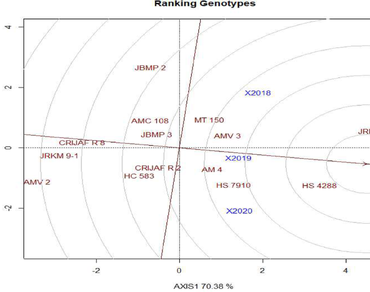
Two species of mesta viz., Hibiscus cannabinus (kenaf) and Hibiscus sabdariffa (roselle) are in cultivation for bast fibres extracted from their stem. Mesta fibres are blended with jute fibres and are collectively called raw jute. It is used in making gunny bags, ropes, twines etc. It is a potential raw material for paper-pulp industries. This crop has remained mostly neglected and its cultivation is very limited. The major limitation in its widespread cultivation is the availability of quality seeds. Therefore, identification of high seed-yielding genotypes becomes essential. Therefore, 14 varieties of mesta (06 kenaf and 08 roselle) were evaluated for seed yielding potential at Central Seed Research Station for Jute & Allied Fibres (ICAR-CRIJAF), Burdwan, West Bengal, India for three years (2018–19 to 2020–21). The seed yield was affected by genotypes and environments but genotype-environment interaction was non-significant. The average seed yield varied from 2.65 to 7.12Q ha−1 with an average of 4.49 Qha−1. Over a period of three-year, the variety JRR 17 had the maximum seed yield (7.12 Q ha−1). It performed best during 2018–19 and 2019–20. During the year 2020–21, the variety HS 4288 performed best followed by the variety HS 7910 and JRR 17. Among all the tested varieties, the roselle variety AMV 3 appeared to be stable. The varieties HS 7910 and CRIJAF R2 were reported as suited to high-performance environments. The measure of the environmental index indicated the suitability of the environment of 1st year on the seed yield of mesta varieties.
References
Abdullah T, Harun Z, Othman MHD, Aminu N, Gabriel O, Aminu T, Ibrahim SA, Kamarudin NH (2018) West African kenaf (Hibiscus cannabinus L.) natural fiber composite for application in automotive industry. Malays J Fundam Appl Sci 14(4):397–402
Abou-Ellail M, El-Nasr TSHA, Ottai MES (2014) Phenotypic and molecular characterization of new selected genotypes of Roselle in Egypt. Middle East J Agri Res 3(1):50–58
Adeniyan ON, Aluko OA, Olanipekun SO, Olasoji JO, Adetumbi JA, Alake CO, Adenekan MO (2014) Genotype × environment interaction and stability analysis in Kenaf (Hibiscus cannabinus L.) for growth and yield performances in Southwest Nigeria. J Agril Sci. https://doi.org/10.5539/jas.v6n8p28
Agbaje GO, Aluko AO, Olasoji JO (2011) Effects of plant spacing on seed yield and yield components in Kenaf (Hibiscus cannabinus) variety, Ifeken 400. Afr J Plant Sci 5(12):718–721
Akinrotimi CA, Okocha PI (2018a) Evaluation of genetic divergence in kenaf (H. cannabinus L.) genotypes using agro-morphological characteristics. J Pl Sci Agril Res 2(12):1–10
Akinrotimi CA, Okocha PI (2018) Effect of planting year and genotypes on the seed yield of kenaf (Hibiscus cannabinus L.). J Pl Sci Agril Res 2(13):45
Akubueze EU, Akinboade DA (2014) Kenaf fibre (Hibiscus cannabinus L.): a viable alternative to jute fibre (Corchorus genus) for agro-sack production in Nigeria. World J Agric Sci 10(6):308–313
Angelini LG, Macchia M, Ceccarini L, Bonari E (1998) Screening of Kenaf (Hibiscus cannabinus L.) genotypes for low temperature requirements during germination and evaluation of feasibility of seed production in Italy. Field Crops Res 59:73–79
Bada BS, Raji KA (2010) Phytoremediation potential of kenaf (Hibiscus cannabinus L.) grown in different soil textures and cadmium concentrations. Afr J Environ Sci Technol 4(5):250–255
Bhandari HR, Bera A, Kar CS, Biswas S (2018) Stability assessment of jute seed production system in lower Gangetic plains of India. Ind Crops Prod 125:505–510
Cheng Z, Lu BR, Sameshima K, Fu DX, Chen JK (2004) Identification and genetic relationships of Kenaf (Hibiscus cannabinus L.) germplasm revealed by AFLP analysis. Genet Resour Crop Evol 51:393–401
Cheshkova AF, Stepochkin PI, Aleynikov AF, Grebennikova IG, Ponomarenko VI (2020) A comparison of statistical methods for assessing winter wheat grain yield stability. Vavilov J Genet Breed 24(3):267–275
Cobley LS (1976) An introduction to botany of tropical crops. Longman Group, UK
Coetzee R, Labuschagne MT, Hugo A (2008) Fatty acid and oil variation in seed from Kenaf (Hibiscus cannabinus L.). Ind Crops Prod 27:104–109
Cosentino SL, Copani V (2003) Leaf photosynthesis in Kenaf (Hibiscus cannabinus L.) in response to water stress. Agroindustria 2:137–145
Crane JC (1949) Roselle-a potentially important plant fiber. Econ Bot 3(1):89–103
Di Candilo M, Faeti(1990) Caratteristiche, importanza e indicazioni di kenaf in Italia Colturali. L’ Informatore Agrario 46, 47–50.
Directorate of Jute Development. https://jute.dac.gov.in/pdf/Mesta-APY.pdf. Accessed on 2nd April 2024. 2019.
Dunne R, Desai D, Sadiku R, Jayaramudu J (2016) A review of natural fibres, their sustainability and automotive applications. J Reinf Plast Compos 35(13):1041–1050
Eberhart SA, Russell WA (1966) Stability parameters for comparing varieties. Crop Sci 6:36–40
Elfaleh I, Abbassi F, Habibi M, Ahmad F, Guedri M, Nasri M, Garnier C (2023) A comprehensive review of natural fibers and their composites: an eco-friendly alternative to conventional materials. Results Eng 19:101271. https://doi.org/10.1016/j.rineng.2023.101271
Erdemci I (2018) Investigation of genotype × environment interaction in chickpea genotypes using AMMI and GGE biplot analysis. Turk J Field Crops 23(1):20–26
Fenner M (2010) Environmental influences on seed size and composition. Hortic. Rev. 45:183–213
Fitria FL, Dhokhikah Y (2019) Removal of chromium from batik wastewater by using kenaf (Hibiscus cannabinus L.) with bed evapotranspiration. IOP Conf Ser Earth Environ Sci 243:012011
Fogorasi MS, Barbu I (2017) The potential of natural fibres for automotive sector- review. IOP Conf Ser Mater Sci Eng 252:012044
Gharehchachi E, Mahvi AH, Shahri SMT, Davani R (2013) Possibility of application of kenaf fibers (Hibiscus cannabinus L.) in water hardness reduction. Desalin Water Treat 52:31–33
Ghorai AK, Saha S, Chakraborty AK (2014) Concentrated jute and mesta leaf manures: its role on summer radish production and its comparative performance with mustard oil cake. Indo-American J Agril Veterinary Sci 2(1):20
Girma T, Philiphos M, Abera S (2015) Profitability study of Hibiscus sabdariffa L. production around Wendo Genet district, Ethiopia. Sci Technol Arts Res J 3(4):214–218
Hamouda HA, Cui S, Dai X, Xiao L, Xie X, Peng H, Ma G (2021) Synthesis of porous carbon material based on biomass derived from Hibiscus sabdariffa fruits as active electrodes for high-performance symmetric supercapacitors. RSC Adv 11:354
Hardy BL, Moncel MH, Kerrfant C, Lebon M, Bellot-Gurlet L, Melard N (2020) Direct evidence of Neanderthal fibre technology and its cognitive and behavioral implications. Sci Rep 10:4889. https://doi.org/10.1038/s41598-020-61839-w
Ibrahim SG, Karim R, Saari N, Abdullah WZW, Zawawi N, Ab Razak AF, Hamim NA, Umar RA (2019) Kenaf (Hibiscus cannabinus L.) seed and its potential food applications. A review. J Food Sci. https://doi.org/10.1111/1750-3841.14714
Ishak MR, Sapuan SM, Leman Z, Rahman MZ, Anwar UMK, Siregar JP (2013) Sugar palm (Arenga pinnata): its fibres, polymers and composites. Carbohydr Polym 91(2):699–710
Islam MM (2019) Kenaf (Hibiscus cannabinus L., Malvaceae) research and development advances in Bangladesh: a review. Nutrit Food Process. https://doi.org/10.31579/2637-8914/010
Jawaid M, Abdul Khalil HPS (2011) Cellulosicsynthetic fibre reinforced polymer hybrid composites: a review. Carbohydr Polym 86(1):1–18
Joshi S, Drzal L, Mohanty A, Arora S (2004) Are natural fiber composites environmentally superior to glass fiber reinforced composites? Compos Part A Appl Sci Manuf 35(3):371–376
Jyothsna S, Appalaswamy A, Lal AM (2014) Stability analysis in roselle (Hibiscus sabdariffa L.) by Eberhart-Russell model. Int J Food, Agri Vet Sci 4(3):151–155
Kalita BB, Jose S, Baruah S, Kalita S, Saikia SM (2019) Hibiscus sabdariffa (Roselle): a potential source of bast fiber. J Nat Fibers 16:49–57
Lavanya AK, Sharma A, Choudhary SB, Sharma HK, Nain PKS, Singh S, Nain L (2020) Mesta (Hibiscus spp.) - a potential feedstock for bioethanol production. Energy Sources Part A Util Environ Eff 42(21):2664–2677
Lin CS, Binns MR, Lefkovitch LP (1986) Stability analysis: where do we stand. Crop Sci 26:894–900
Marjani Budi US, Murianingrum M (2019) Yield stability and adaptability of kenaf (Hibiscus cannabinus L.) genotypes at different kenaf growing regions in Indonesia. IOP Conf Ser Earth Environ Sci. https://doi.org/10.1088/1755-1315/418/1/012076
Mostofa MG, Rahman L, Hussain MM (2011) Combining ability for yield and yield contributing characters in kenaf (Hibiscus cannabinus L.). Bangladesh J Pl Breed Genet 24(1):01–06
Mwaikambo L (2006) Review of the history, properties and application of plant fibres. Afr J Sci Technol 7(2):120–133
Mwasiagi JI, Yu CW, Phologolo T, Waithaka A, Kamalha E, Ochola JR (2014) Characterization of the Kenyan Hibiscus sabdariffa L. (roselle) bast fibre. Fibres Text East Eur 3(105):31–34
Nadlene R, Sapuan SM, Jawaid M, Ishak MR, Yusriah L (2015) Material characterization of roselle fibre (Hibiscus sabdariffa L.) as potential reinforcement material for polymer composites. FibresText East Eur 6(114):23–30
Ngom BD, Ndiaye NM, Sylaa NF, Mutuma BK, Manyala N, Chaker M (2021) Binary vanadium pentoxide carbon-graphene foam composites derived from dark red Hibiscus sabdariffa for advanced asymmetric supercapacitor. Philos Trans R Soc A Math Phys Eng Sci 379:20200347. https://doi.org/10.1098/rsta.2020.0347
Olasoji JO, Aluko OA, Agbaje GO, Adeniyan ON, Kareem KO, Olanipekun SO (2014) Studies on seed yield potential of some selected kenaf (Hibiscus cannabinus L.) genotypes. Afr J Biotech 13(24):2420–2424
Park H, Park SU, Jang BK, Lee JJ, Chung YS (2020) Germplasm evaluation of kenaf (Hibiscus cannabinus) for alternative biomass for cellulosic ethanol production. GCB Bioenergy 13:201–210
Patane C, Sortino O (2010) Seed yield in kenaf (Hibiscus cannabinus L.) as affected by sowing time in south Italy. Ind Crops Prod 32:381–388. https://doi.org/10.1016/j.indcrop.2010.06.002
Poongodi B, Ramakrishnan G, Nived R, Gowtham S (2021) Kenaf - a promising way into sustainable textiles environment development of kenaf-cotton blended yarn and fabrics for sustainable textiles. Int Res J Eng Technol 8(4):5139–5145
Pushpa K, Murthy KN, Murthy KR (2013) Growth and yield parameters of mesta varieties as influenced by spacing and nutrient sources. J Agric Sci. https://doi.org/10.5539/jas.v5n3p105
Pushpa K, Murthy KR (2010) Seed yield and oil yield of mesta varieties as influenced by spacing and nutrient sources. An Asian J Soil Sci 5(1):218–224
Richardson ML, Arlotta CG (2021) Differential yield and nutrients of Hibiscus sabdariffa L. genotypes when grown in urban production systems. Scient Hort. https://doi.org/10.1016/j.scientia.2021.110349
Salami SO, Afolayan AJ (2021) Evaluation of nutritional and elemental compositions of green and red cultivars of roselle: Hibiscus sabdariffa L. Sci Rep 11:1030. https://doi.org/10.1038/s41598-020-80433-8
Samage A, Halakarni M, Ghosh D, Nataraj SK (2022) High power, long cycle life capacitive carbon from Hibiscus cannabinus, a agri-bio-waste with simultaneous value addition in water treatment application. Chem Eng J. https://doi.org/10.1016/j.cej.2022.134952
Sanchez-Feria C, Gonzalez-Hernandez VA, Salinas-Moreno Y, Cruz-Huerta N (2017) Genotype and environmental effects on physical and chemical qualities of Mexican varieties of Hibiscus sabdariffa L. flowers. Agrociencia 51:525–541
Shah SSM, Luthfi AAI, Low KO, Harun S, Manaf SFA, Illias RM, Jahim JM (2019) Preparation of kenaf stem hemicellulosic hydrolysate and its fermentability in microbial production of xylitol by Escherichia coli BL21. Sci Rep. https://doi.org/10.1038/s415980-019-40807-z
Shehata SM, Badawy RK, Aboulsoud YIE (2019) Phytoremediation of some heavy metals in contaminated soil. Bull Natl Res Cent 43:189. https://doi.org/10.1186/s42269-019-0214-7
Uddin Nizam M, Wahid-U-Zzaman M, Mokhlesur Rahman M, Kim Jang E (2016) Phytoremediation potential of kenaf (Hibiscus cannabinus L.), mesta (Hibiscus sabdariffa L.,) and jute (Corchorus capsularis L.) in Arsenic-contaminated soil. Korean J Environ Agri 35(2):111–120
Yan W, Hunt LA, Sheng Q, Szlavnics Z (2000) Cultivar evaluation and mega-environment investigatin based on the GGE biplot. Crop Sci 40:597–605
Yan W, Hunt LA (2002) Biplot analysis of diallel data. Crop Sci 42(1):243–253
Yusriah L, Sapuan SM, Zainudin ES, Mariatti M (2012) Exploring the potential of betel nut husk fiber as reinforcement in polymer composites: effect of fiber maturity. Procedia Chem 4:87–94
Zhang L, Wan X, Xu J, Lin L, Qi J (2015) De novo assembly of kenaf (Hibiscus cannabinus) transcriptome using Illumina sequencing for gene discovery and marker identification. Mol Breed 35:192–202
Zhang L, Xu Y, Zhang X, Ma X, Zhang L, Liao Z, Zhang Q, Wan X, Cheng Y, Zhang J, Li D, Zhang L, Xu J, Tao A, Lin L, Fang P, Chen S, Qi R, Xu X, Qi J, Ming R (2020) The genome of kenaf (Hibiscus cannabinus L.) provides insights into bast fibre and leaf shape biogenesis. Plant Biotechnol J 18:1796–1809
Author Information
Directorate of Onion and Garlic Research (ICAR-DOGR), Pune, India