Vegetos

(An International Journal of Plant Research & Biotechnology)
(eISSN: 2229-4473)
Hormonal regulation of prickly pear micropropagation and CemA gene expression under PEG stress
*Article not assigned to an issue yet
Alabtan Manaf K. M., Alqaisi Mustafa R. M., Abbas Adib Jassim
Research Articles | Published: 26 September, 2026
First Page: 0
Last Page: 0
Views: 97
Keywords: Cladodes, Micropropagation, Osmotic stress, Phytohormone, Polyethylene glycol, Signal transduction
Abstract
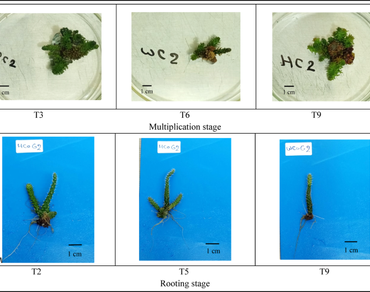
This study aimed to optimize the micropropagation of three Opuntia ficus-indica hybrids (Red, White, and Honey) and evaluate plastid-associated CemA (ycf10) gene expression under polyethylene glycol (PEG)-induced osmotic stress. Young cladodes were cultured on MS medium to identify optimal sterilization and plant growth regulator (PGR) combinations, followed by PEG 6000 exposure. Sterilization with 2.4% NaClO for 12 min maximized healthy explant recovery (88–94%). Significant genotype × PGR interactions emerged during multiplication; 2.0 mg L?1 BA and 0.2 mg L?1 IBA yielded the highest shoot proliferation, with the Red hybrid producing 8.0 shoots per explant. Conversely, the Honey hybrid achieved superior rooting (93%) in hormone-free medium. Under severe osmotic stress (20 g L?1 PEG), the Red hybrid exhibited adaptive morphological responses, increasing root proliferation from 4.8 to 8.0, while the Honey hybrid root count declined from 10.6 to 7.0 roots due to osmotic growth inhibition. Crucially, CemA expression was strictly genotype-dependent: it was upregulated 3.031-fold in the resilient Red hybrid—thereby supporting physiological stability under dehydration—but severely repressed (0.165-fold) in the sensitive Honey hybrid. These findings demonstrate that in vitro morphogenic and stress responses are strongly genotype-driven, identifying CemA transcriptional stability as a functional contributor to osmotic tolerance and a promising molecular marker for screening resilient cacti.
References
Akhtar A, Javed S, Ahmad A (2024) Stress biology in plant tissue culture: recent advances. Stress biology in photosynthetic organisms. Springer, Singapore, pp 185–211. https://doi.org/10.1007/978-981-97-1883-2_9
Alqaisi MR, Mohsin RM, Ahmed TS (2020) Efficiency of image analysis as a direct method in spore dimensions measurement. Plant Cell Biotechnol Mol Biol 21:57–64
AOAC (2005) Official methods of analysis. Association of Official Analytical Chemists, Washington
Arellano-Perusquía A, López-Peralta MCG, Chablé-Moreno F, Estrada-Luna AA (2013) Effect of growth regulators on the organogenesis and multiplication of Ortegocactus macdougallii Alexander. Propag Ornam Plants 13:160–167
Bouzroud S, El Maaiden E, Sobeh M, Devkota KP, Boukcim H, Kouisni L, El Kharrassi Y (2022) Micropropagation of Opuntia and other cacti species through axillary shoot proliferation: a comprehensive review. Front Plant Sci 13:926653. https://doi.org/10.3389/fpls.2022.926653
Carmona-Martín E, Conde F, Petri C (2025) Progress towards in vitro shoot regeneration and genetic transformation in pitaya (Hylocereus undatus) cladode sections. Plant Cell Tissue Organ Cult 162:37. https://doi.org/10.1007/s11240-025-03153-9
Elias H, Taha RM, Hasbullah NA, Mohamed N, Manan AA, Mahmad N, Mohajer S (2015) The effects of plant growth regulators on shoot formation, regeneration and coloured callus production in Echinocereus cinerascens in vitro. Plant Cell Tissue Organ Cult 120:729–739. https://doi.org/10.1007/s11240-014-0642-x
Fan Y, Wang Q, Kang L, Liu W, Xu Q, Xing S, Sang T (2015) Transcriptome-wide characterization of candidate genes for improving the water use efficiency of energy crops grown on semiarid land. J Exp Bot 66:6415–6429. https://doi.org/10.1093/jxb/erv353
Fang Y, Xiong L (2015) General mechanisms of drought response and their application in drought resistance improvement in plants. Cell Mol Life Sci 72:673–689. https://doi.org/10.1007/s00018-014-1767-0
Fedoreyeva LI (2024) ROS as signaling molecules to initiate the process of plant acclimatization to abiotic stress. Int J Mol Sci 25:11820. https://doi.org/10.3390/ijms252111820
Garcia-Saucedo PA, Valdez-Morales M, Valverde ME, Cruz-Hernández A, Paredes-López O (2005) Plant regeneration of three Opuntia genotypes used as human food. Plant Cell Tissue Organ Cult 80:215–219. https://doi.org/10.1007/s11240-004-9158-0
Ghaffari A, Hasanloo T, Nekouei MK (2013) Micropropagation of tuna (Opuntia ficus-indica) and effect of medium composition on proliferation and rooting. Int J Biosci 3:129–139. https://doi.org/10.12692/ijb/3.11.129-139
Ghanim NS, Jayed GA (2024) The effect of brassinolide on active compounds production of callus of Ocimum basilicum L. in vitro. Tikrit J Agric Sci 24:255–265. https://doi.org/10.25130/tjas.24.4.21
Hosseini N, Ghasimi Hagh Z, Khoshghalb H (2020) Morphological, antioxidant enzyme activity and secondary metabolites accumulation in response of polyethylene glycol-induced osmotic stress in embryo-derived plantlets and callus cultures of Salvia leriifolia. Plant Cell Tissue Organ Cult 140:143–155. https://doi.org/10.1007/s11240-019-01718-z
Hu W, Fagundez S, Katin-Grazzini L, Li Y, Li W, Chen Y, Wang X, Deng Z, Xie S, McAvoy RJ (2017) Endogenous auxin and its manipulation influence in vitro shoot organogenesis of citrus epicotyl explants. Hortic Res 4:17071. https://doi.org/10.1038/hortres.2017.71
Huber KC, BeMiller JN (2024) Carbohydrate analysis. In: Ismail BP, Nielsen SS (eds) Nielsen’s food analysis. Food science text series. Springer, Cham. https://doi.org/10.1007/978-3-031-50643-7_19
Khalafalla MM, Abdellatef E, Ahmed MM, Osman MG (2007) Micropropagation of cactus (Opuntia ficus-indica) as a strategic tool to combat desertification in arid and semi-arid regions. Int J Sustain Crop Prod 2:1–8
Knudson LL, Tibbitts TW, Edwards GE (1977) Measurement of ozone injury by determination of leaf chlorophyll concentration. Plant Physiol 60:606–608. https://doi.org/10.1104/pp.60.4.606
Lema-Rumi?ska J, Kulus D (2014) Micropropagation of cacti—a review. Haseltonia 19:46–63. https://doi.org/10.2985/026.019.0107
Livak KJ, Schmittgen TD (2001) Analysis of relative gene expression data using real-time quantitative PCR and the 2−ΔΔCT method. Methods 25:402–408. https://doi.org/10.1006/meth.2001.1262
Mabrouk A, Abbas Y, El Goumi Y, El Maaiden E, El Kharrassi Y, El Antry-Tazi S, El Mzouri EH, Fakiri M (2021) Optimization of prickly pear cacti (Opuntia spp.) micropropagation using an experimental design method. J Microbiol Biotechnol Food Sci 11:e1577. https://doi.org/10.15414/jmbfs.1577
Makhloufi NE, Mazri MA, Tabi S, Manssoury NE, Tahiri A, Naimi M, Koufan M (2025) Influence of drought and salt stresses on the morpho-physiological and biochemical properties of in vitro seedlings of carob (Ceratonia siliqua L.). Vegetos. https://doi.org/10.1007/s42535-025-01360-5
Marhri A, Tikent A, Garros L, Merah O, Elamrani A, Hano C, Abid M, Addi M (2023) Rapid and efficient in vitro propagation protocol of endangered wild prickly pear growing in eastern Morocco. Horticulturae 9:491. https://doi.org/10.3390/horticulturae9040491
Martel-Ortiz D, González-De Zayas R, Concepción O, Escalona M, Hajari E, Lorenzo JC, Hernández-Fernández L (2025) In vitro culture of Consolea millspaughii subsp. millspaughii (Cactaceae): a critically endangered species. Vegetos 38:1707–1712. https://doi.org/10.1007/s42535-024-00972-7
Mazri MA, Koufan M, Abdelwahd R, Belkoura I (2022) In vitro responses of some Mediterranean fruit crops to auxin, cytokinin and gibberellin treatments. Auxins, cytokinins and gibberellins signaling in plants. Springer International Publishing, Cham, pp 91–123. https://doi.org/10.1007/978-3-031-05427-3_5
Monroy-Vázquez ME, Peña-Valdivia CB, García-Nava JR, Solano-Camacho E, Campos H, García-Villanueva E (2017) Imbibition, viability and vigor of seeds of four Opuntia species with different degree of domestication. Agrociencia 51:27–42
Moradi L, Mortazavi SN, Alaei M (2024) The effect of time and different concentrations of sodium hypochlorite, carbendazim fungicide and mercuric chloride in inhibiting the contamination of Fritillaria spp. bulbs in tissue culture environment. J Hortic Sci 38:465–478. https://doi.org/10.22067/jhs.2024.86540.1322
Murashige T, Skoog F (1962) A revised medium for rapid growth and bio assays with tobacco tissue cultures. Physiol Plant 15:473–497. https://doi.org/10.1111/j.1399-3054.1962.tb08052.x
Resende SV, Lima-Brito A, Torres-Silva G, Ferreira de Santana JR (2021) In vitro seed germination and plant growth of “cabeça-de-frade” (Cactaceae). Rev Caatinga 34:1–8. https://doi.org/10.1590/1983-21252021V34N101RC
Rodríguez OJL, Ramirez-Pantoja PE (2020) Micropropagation of selected materials of Opuntia ficus-indica L through culture in vitro of areola. J Appl Biotechnol Bioeng 7:121–126. https://doi.org/10.15406/jabb.2020.07.00225
Shehu UI, Sani LA, Ibrahim AB (2016) Auxin-induced rooting of cactus pear (Opuntia ficus-indica L. Miller) cladodes for rapid on-farm propagation. Afr J Agric Res 11:898–900. https://doi.org/10.5897/AJAR2015.10592
Shipley B, Vu T-T (2002) Dry matter content as a measure of dry matter concentration in plants and their parts. New Phytol 153:359–364. https://doi.org/10.1046/j.0028-646X.2001.00320.x
Song K, Kang H, Ak G, Zengin G, Cziáky Z, Jek? J, Kim DH, Lee ON, Sivanesan I (2021) Micropropagation, phytochemistry and biological activity of the critically endangered Mammillaria herrerae Werdermann. S Afr J Bot 143:312–321. https://doi.org/10.1016/j.sajb.2020.11.025
Tahiri A, Ait Aabd N, Qessaoui R, Mimouni A, Bouharroud R (2025) Genetic diversity and breeding of cactus (Opuntia spp.). In: Al-Khayri JM, Jain SM, Wani MA (eds) Breeding of ornamental crops: potted plants and shrubs. Advances in Plant Breeding Strategies. Springer, Cham
Tesfay YB, Blaschke A, Ashley N, Portillo L, Scalisi A, Adli B, Kreyling J (2023) Increased plasticity in invasive populations of a globally invasive cactus. Plants (Basel) 12:3287. https://doi.org/10.3390/plants12183287
Touaf I, El Finti A, Lagram K et al (2025) Micropropagation in vitro of Opuntia ficus-indica through axillary buds’ proliferation: a review. In Vitro Cell Dev Biol Plant 61:1051–1065. https://doi.org/10.1007/s11627-025-10548-y
Trinh MDL, Masuda S (2022) Chloroplast pH homeostasis for the regulation of photosynthesis. Front Plant Sci 13:919896. https://doi.org/10.3389/fpls.2022.919896
Tsehaye KE, Kiros-Meles A (2023) Propagation of cochineal scale insect free cactus (Opuntia ficus-indica) by in vitro regeneration culture technique in Tigray, Ethiopia. Afr J Biotechnol 22:119–125. https://doi.org/10.5897/ajb2022.17529
Ujjainkar NR, Panpatil AU, Chimote VP, Pawar BD, Kale AA (2025) Molecular characterization of late embryogenesis abundant proteins encoding genes from wild sorghum genotype IS-18,909 expressed under drought stress. Vegetos 38:911–920. https://doi.org/10.1007/s42535-024-00856-w
Waszczak C, Carmody M, Kangasjärvi J (2018) Reactive oxygen species in plant signaling. Annu Rev Plant Biol 69:209–236. https://doi.org/10.1146/annurev-arplant-042817-040322
Zoghlami N, Bouamama B, Khammassi M, Ghorbel A (2012) Genetic stability of long-term micropropagated Opuntia ficus-indica (L.) Mill. plantlets as assessed by molecular tools: perspectives for in vitro conservation. Ind Crops Prod 36:59–64. https://doi.org/10.1016/j.indcrop.2011.08.006
Author Information
Presidency of Al-Nahrain University, Baghdad, Iraq