Vegetos

(An International Journal of Plant Research & Biotechnology)
(eISSN: 2229-4473)
Genotype × environment analysis reveals differential responses of yield and grain nutritional traits in rice
*Article not assigned to an issue yet
Research Articles | Published: 25 October, 2026
First Page: 0
Last Page: 0
Views: 25
Keywords: GGE, G?×?E, Lipid, Protein, Oryzanol, Quality
Abstract
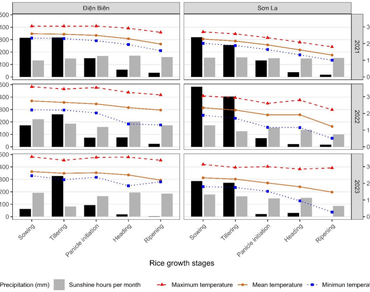
Grain yield and nutritional quality in rice are complex traits governed by genotype, environment, and genotype × environment (G?×?E) interactions. Therefore, multi-environment evaluation is essential to identify genotypes that combine high productivity, desirable quality, and stable performance across the environments. This study evaluated 11 rice genotypes at two sites in northern Vietnam, Dien Bien and Son La, over three consecutive years. Biomass, grain yield, yield components, protein, lipid, and ?-oryzanol content were assessed. The results revealed that genotype was the primary determinant of phenotypic variation across all evaluated traits, whereas site effects and genotype × site interactions were more consistently statistically significant than year-related effects and genotype × year interactions. Dien Bien generally exhibited higher biomass, grain yield, protein, and lipid content than Son La, whereas ?-oryzanol differed less consistently between sites. Grain yield was more strongly influenced by G?×?E than grain quality traits. Ja35 exhibited superior grain yield together with high lipid and ?-oryzanol contents but lower yield stability, whereas Nep Tan SL showed outstanding protein content. MGIDI-based multi-trait ranking further identified Ja35, Nep Tan SL, Ja12, and Nep Lao as the best overall-performing genotypes across environments. Regression analysis indicated that minimum temperature was the climatic variable most consistently associated with the tested traits. These findings highlight the importance of G?×?E interactions and thermal conditions in shaping rice productivity and nutritional quality, and provide useful information for genotype selection and breeding strategies in heterogeneous agro-ecological environments.
References
Bergman CJ, Xu Z (2003) Genotype and environment effects on tocopherol, tocotrienol, and γ-oryzanol contents of Southern U.S. rice. Cereal Chem 80:446–449. https://doi.org/10.1094/CCHEM.2003.80.4.446
Fasahat P, Muhammad K, Abdullah A, Rahman BMA, Siing NM, Gauch JHG, Ratnam W (2014) Genotype× environment assessment for grain quality traits in rice. Commun Biometry Crop Sci 9:71–82
Fukai S, Mitchell J (2024) Grain yield and protein concentration relationships in rice. Crop Environ 3:12–24. https://doi.org/10.1016/j.crope.2023.11.002
Ghazy MI, Abdelrahman M, El-Agoury RY, El-hefnawy TM, EL-Naem SA, Daher EM, Rehan M (2023) Exploring genetics by environment interactions in some rice genotypes across varied environmental conditions. Plants https://doi.org/10.3390/plants13010074
Ghosh S, Bollinedi H, Krishnan SG, Bhowmick PK, Nagarajan M, Vinod K, Ellur RK, Singh AK (2023) Grain γ-oryzanol and its constituent compounds show high genetic variability, diversity and significant site × genotype interactions in rice (Oryza sativa L). Indian J Genet Plant Breed 83:157–167
Habib MA, Azam MG, Haque MA, Hassan L, Khatun MS, Nayak S, Abdullah HM, Ullah R, Ali EA, Hossain N, Ercisli S, Sarker U (2024) Climate-smart rice (Oryza sativa L.) genotypes identification using stability analysis, multi-trait selection index, and genotype-environment interaction at different irrigation regimes with adaptation to universal warming. Sci Rep 14:13836. https://doi.org/10.1038/s41598-024-64808-9
Huang X, Jang S, Kim B, Piao Z, Redona E, Koh H-J (2021) Evaluating genotype × environment interactions of yield traits and adaptability in rice cultivars grown under temperate, subtropical and tropical environments. Agriculture 11:558. https://doi.org/10.3390/agriculture11060558
Nguyen HP, Nguyen TTH, Nguyen TQ, Nguyen DT, Nguyen TNH, Nguyen VK, Pham VC (2024) Influence of ecological sub-region on productivity and quality of brown rice of some rice varieties in the Northwest Region. Vietnam J Agri Sci 22:1265–1273
Nguyen KV, Nguyen PH, Hoang MT, Dinh PT, Pham CV, Phan NTH (2025) Diversity in protein, lipids, and γ-oryzanol contents of glutinous rice landraces in northwest Vietnam. Genet Resour Crop Evol 72:6567–6579. https://doi.org/10.1007/s10722-025-02340-z
Oliveira ICM, Guilhen JHS, Ribeiro PC, de O. Gezan SA, Schaffert RE, Simeone MLF, Damasceno CMB, de S. Carneiro JE, Carneiro PCS, da C. Parrella RA, Pastina MM (2020) Genotype-by-environment interaction and yield stability analysis of biomass sorghum hybrids using factor analytic models and environmental covariates. Field Crops Res 257:107929. https://doi.org/10.1016/j.fcr.2020.107929
Olivoto T, Diel MI, Schmidt D, Lúcio AD (2022) MGIDI: a powerful tool to analyze plant multivariate data. Plant Methods 18:121. https://doi.org/10.1186/s13007-022-00952-5
Olivoto T, Lúcio AD (2020) metan: An R package for multi-environment trial analysis. Methods Ecol Evol 11:783–789. https://doi.org/10.1111/2041-210X.13384
Priyanga D, Amudha K, Sakthivel N, Sivasakthivelan P, Utharasu S, Uma D, Sudha M (2025) Functional and nutraceutical potential of Indian Rice landraces: a comprehensive scientific review. Rice Sci 32:777–796. https://doi.org/10.1016/j.rsci.2025.08.009
Zeng Y, Zhang Y, Xiang J, Uphoff NT, Pan X, Zhu D (2017) Effects of low temperature stress on spikelet-related parameters during anthesis in indica–japonica hybrid rice. Front Plant Sci 8:1350. https://doi.org/10.3389/fpls.2017.01350
Author Information
Tay Bac University, Son La, Vietnam