Vegetos

(An International Journal of Plant Research & Biotechnology)
(eISSN: 2229-4473)
First report of Marasmius inthanonensis (Marasmiaceae) from India
*Article not assigned to an issue yet
Research Article | Published: 20 April, 2026
First Page: 0
Last Page: 0
Views: 595
Keywords: Uttarakhand, New record, nrITS, Taxonomy, Phylogeny
Abstract
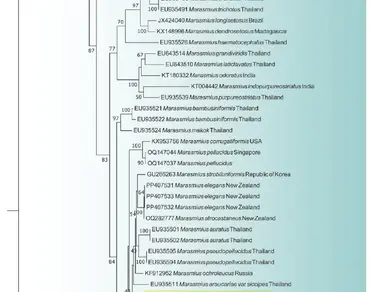
In this present communication, Marasmius inthanonensis belonging to the family Marasmiaceae is described from the state Uttarakhand. It was found in association with Quercus leucotrichophora and is characterized by smooth pileus, olive-brown when young, fading to brownish-orange and then yellowish-brown with age lamellae close, broad and yellowish-grey with light brown edges. Marasmius inthanonensis is presented here as a new record for the Indian mycobiota and its identity is based on detailed morphology, anatomy and nrITS based phylogeny.
References
Altschul SF, Madden TL, Schaffer AA, Zhang J, Zhang Z, Miller W, Lipman DJ (1997) Gapped BLAST and PSI-BLAST: a new generation of protein database search programs. Nucleic Acids Res vol 25:3389–3402
Antonín V (2007) Monograph of Marasmius, Gloiocephala, Palaeocephala and Setulipes in Tropical Africa. Fung Fl Trop Afr 1:1–164
Antonín V, Noordeloos ME (2010) A monograph of marasmioid and collybioid fungi in Europe. IHW-, Eching
Deng SF (2016) Taxonomy of Gymnopus and preliminary study of Marasmiaceae resource in South China. Master Thesis, South China Agricultural University, China
Dutta AK, Das K, Acharya K (2015) A new species of Marasmius sect. Globulares from Indian Himalaya with tall basidiomata. Mycosphere 6(5):560–567
Edler D, Klein J, Antonelli A, Silvestro D (2019) raxmlG UI 2.0 beta: a graphical interface and toolkit for phylogenetic analyses using RAxML. bioRxiv
Farook VA, Manimohan P (2015) Marasmius odoratus—a new jasmine-scented species of Marasmius section Globulares from India. Phytotaxa 227(3):275
Katoh K, Standley DM (2013) MAFFT multiple sequence alignment software ver. 7: improvement in performance and usability. Mol Biol Evol 30:772–780
Kiyashko AA, Malysheva EF, Antonín V, Svetasheva TY, Bulakh EM (2014) Fungi of the Russian Far East 2. New species and new records of Marasmius and Cryptomarasmius (Basidiomycota). Phytotaxa 186:1–28
Kornerup A, Wanscher JH (1978) Methuen Handbook of Colour, 3rd edn. Eyre Methuen Ltd., London, U.K, p 252
Lodge DJ, Chapela I, Samuels G, Uecker FA, Desjardin D, Horak E, Milller OK, Hennebert G, Decock CA, Ammirati J, Burdsall HH Jr, Krik PM, Minter DW, Hailing R, Læssøe T, Mueller G, Huhndorf S, Oberwinkler F, Pegler DN, Spooner B, Petersen RH, Rogers JD, Ryvarden L, Watling R, Turnbull E, Whalley AJS (1995) A survey of patterns of diversity in non-lichenized fungi. Mitt. Eidgenössische Forschungsanstalt für Wald, Schnee und Landschaft. 70:157–173
Lu S, Wang XW, Li GJ, Deng CY, Rossi W, Leonardi et al (2023) Fungal diversity notes 1717–1817: taxonomic and phylogenetic contributions on genera and species of fungal taxa. Fungal Divers 124(1):1
Oliveira JJS, Moncalvo JM, Margaritescu S, Capelari M (2020) 0Phylogenetic and morphological analyses of species of Marasmius sect. Marasmius from the Atlantic Rainforest, Brazil. Plant Syst Evol 306:1–46
Shahina A, Sharafudheen, Manimohan P (2018) A new species of Marasmius section Globulares from Kerala State, India. Phytotaxa 364(1):092–100
Singer R (1976) Marasmieae (Basidiomycetes – Tricholomataceae). Fl Neotrop Monogr 17:1–347
Singer R (1986) The Agaricales in modern taxonomy, 4th edn. Koeltz Scientific Books, Koenigstein
Tan YS, Desjardin DE, Perry BA, Vikineswary S, Noorlidah A (2009) Marasmius sensu stricto in Peninsular Malaysia. Fungal Divers 37:9–100
Wannathes N, Desjardin DE, Hyde KD, Perry BA, Lumyong S (2009) A monograph of Marasmius (Basidiomycota) from Northern Thailand based on morphological and molecular (ITS sequences) data. Fungal Divers 37:209–306
Author Information
Department of Botany, University of Jammu, Jammu, India